


.png)
At SAP Connect 2026, Deloitte and Semos Cloud showed how Deloitte replaced a homegrown nomination tool and a separate gift card vendor with one Recognition Hub for 200,000 professionals in the US and India. Powered by Semos Cloud, the Recognition Hub brings recognition into one place, with award data governed in SAP Business Data Cloud alongside SuccessFactors and S/4HANA.
Four months after go-live, adoption has set a new record every month. Each award is now a structured data record that captures the behaviors and values Deloitte wants to encourage.
Recognition is not just a moment in time
Kara Reed, Product Marketing Director for Data and AI at SAP, opened the last session of SAP Connect with two questions for the room. Raise your hand if your company has a recognition program. Most hands went up. Now raise your hand if you know what happens to that data once it is submitted. Almost none did.
That gap is what the session was about. Filip Misovski, CEO of Semos Cloud, and Peter DeMartin, Managing Director and Compensation & Recognition Leader at Deloitte, walked through how Deloitte and Semos Cloud moved the firm from multiple systems and local practices to one integrated recognition experience, with the data governed in SAP Business Data Cloud, and why the data underneath it matters as much as the experience on top.
"Recognition is the one place that really captures the culture of your company. It's a signal that tells you whether the culture is working or not, and how it's perceived across locations and organizational units."
- Filip Misovski, CEO, Semos Cloud
[cta]
Where Deloitte started: two systems doing one job
Before 2018, recognition at Deloitte meant cash awards. Between 2018 and 2019 the firm built its own nomination platform in-house to handle workflows, approvals and budgets, and paired it with an outside vendor for electronic gift cards. There was even a period of plastic gift cards sent by post, which tended to get lost in the mail.
It got the job done, and not much more. Much of the process ran on email. The experience in the US and India, the firm's two largest populations, was inconsistent, and the gift card catalog was stronger in one country than the other.
About two and a half years ago Deloitte moved its HRIS to SAP SuccessFactors. Recognition was next.
Deloitte describes itself as the largest privately owned partnership in the world, and its culture shaped how the project began. Before a vendor was chosen, the team met with leaders, partners and managing directors across the business to map every interface point the new platform would need to touch.
What did Deloitte require from a global employee recognition platform?
- One roof. The nomination experience and the points and gift card experience in one integrated tool, not two vendors stitched together.
- Differentiation by talent model. Deloitte's talent models give different parts of the workforce different experiences. Recognition had to follow them, by country and by population, today and as the models evolve.
- A better talent experience. Every change in the talent organization is judged first by whether it improves the experience of Deloitte's people.
- A simpler technology landscape. Fewer vendors living outside the ecosystem, and more running under the SAP umbrella next to SuccessFactors.
How a single award becomes governed data
Governed recognition data is captured under defined program rules and stored in structured records, including who gave and received the recognition, the reason, and any applicable award amount or company value. This supports consistency and traceability and makes the data easier to connect with other business data.
Filip's architecture slide showed how those requirements translate into layers.
At the top is one entry point: a Recognition Hub tile inside SuccessFactors and Deloitte's internal portal. In the middle sit the rules and governance for every program: eligibility, talent model, job level, approvals and individual budgets, all built on employee data from SuccessFactors. Every award is stored as a structured record holding the giver, the receiver, the program, the value, the company value it reflects, and the reason behind it.
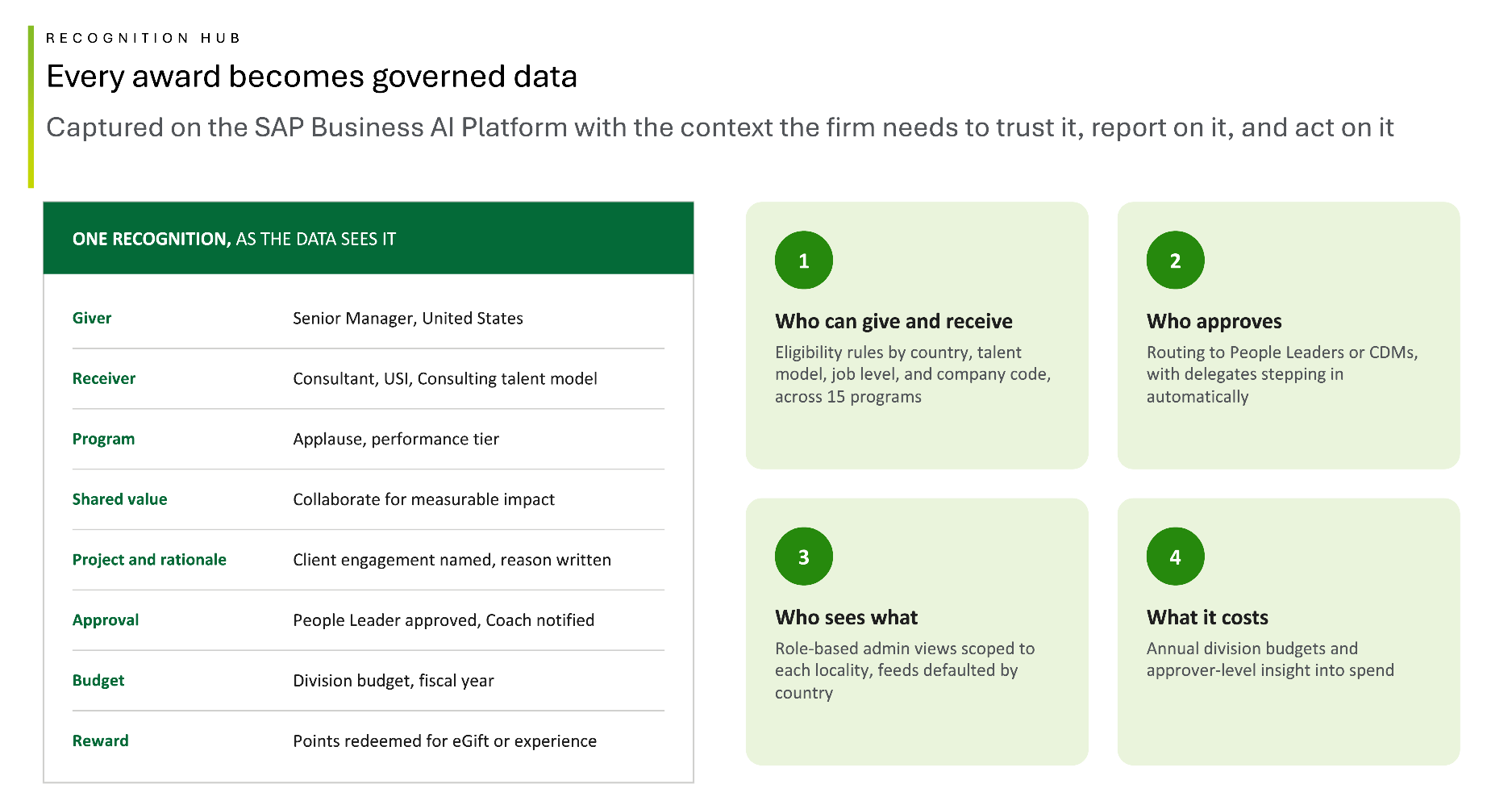
Underneath, that record lives in SAP Business Data Cloud on the HANA Cloud layer, next to SuccessFactors organizational data and S/4HANA financial data. A two-way payroll integration handles taxation and cash-paid programs. Generative AI runs through SAP's Generative AI Hub under the same governance, and SAP Analytics Cloud connects recognition to tenure, retention and other workforce KPIs.
The same foundation already runs recognition inside SAP itself, where Semos Cloud has been in use for about eight years. Filip shared one detail from that rollout: SAP alumni who, on their last day, downloaded every recognition they had ever received, because it was the record that stayed with them.
Designing for the nominator, not just the receiver
Deloitte's old tool was built around the person receiving recognition. Peter's starting point for the new one was the person giving it.
"If our nominators don't feel like it's easy and quick for them to make a nomination, the employee experience doesn't even happen, because people aren't getting nominated."
- Peter DeMartin, Managing Director, Deloitte
The old nomination form was a page of drop-downs. The new one is a few clicks, and every award is tied to one of Deloitte's five values. The Recognition Hub, carrying Deloitte's own black and green branding, now offers three types of recognition from a single landing page:
- Shout-outs. Non-monetary, open to everyone, and posted to a social wall that scrolls on the landing page, with an email notification to the person recognized.
- Applause awards. Points redeemed for electronic gift cards and experiences, with set denominations. Low-value spot awards, around $25, need no approval so they stay fast.
- Outstanding performance awards. Monetary awards over $1,000, paid through payroll in dollars or rupees.
Catalog parity mattered too. Employees in India now have as many good options as their US colleagues, including experiences such as travel, which Peter said have been especially popular.
What the first four months taught them
Peter was candid about what to plan for. Four lessons stood out:
- Data quality. Around 95% of the SuccessFactors attributes fed into the platform behaved as expected. A few did not, and that only surfaced after go-live. Test the attributes your workflows depend on.
- Invoicing by legal entity. Deloitte operates through many legal entities, especially in India, and invoices have to break out by entity and by business. Build that into the design early.
- The support model. Employees just want an answer. Decide up front which questions go to the vendor help center and which to the internal one. Support volume stayed low, even at go-live.
- The timeline is yours. The implementation could have run in under six months. Deloitte staged it over roughly a year to fit internal IT windows, and pushed go-live a couple of weeks past June 1 so another firm-wide rollout could settle first. Peter called that a good decision.
One requirement surprised even Semos Cloud. Deloitte's people leaders approve awards and can delegate approval, for example to a chief of staff. The volume of delegation changes turned out to be far higher than in any other deployment, and none of it lived in SuccessFactors, so Semos Cloud built dedicated delegation functionality for the go-live release.
On admin, the payoff is already visible. Recognition is nobody's full-time job on Peter's team. Deloitte used to build a quarterly recognition report for leadership by hand in PowerPoint. The first report from the new platform is coming straight from its dashboards.
Deloitte did not do this alone internally either. Its own Human Capital consulting practice ran the vendor scan, brought design expertise from other client work, and prepared the team for the design questions any vendor would ask, so the answers were ready before implementation started.
[cta-2]
Four months in
Deloitte went live in June. Since then, according to Filip, adoption has set a new record every month, with peer shout-outs and monetary awards growing together, and the strongest quarter for recognition programs still ahead. Several Deloitte colleagues at the conference stopped by to say how simple the new experience is, both for employees and for the leaders who now see what their teams are being recognized for.
From signal to action: where this goes next
The first step was to simplify and modernize the experience and govern every award, approval, budget and delegation. The second is connecting that data in Business Data Cloud. The next step, not yet live at Deloitte, is acting on it.
Filip showed where that leads: agents that turn recognition signals into a next step for managers and HR. An engagement signal comes with a suggested action. A retention signal flags someone who has not been recognized and says what a manager can do. Skills and total rewards signals follow the same pattern, and every signal can be questioned, explained or paused for review. With Joule and the agent-to-agent protocol, giving recognition will also work conversationally inside Joule.
It is a direction rather than a finished state, and it depends on the foundation Deloitte has now built: clean, governed recognition data sitting next to the rest of the people and finance data.
Three ways to start
The session closed with three entry points, depending on where an organization is today:
- Not ready to change your program yet. A complimentary one-day Future of Rewards workshop, run by Deloitte and Semos Cloud, that ends in a total rewards action plan.
- Ready to modernize recognition. Semos Cloud is available on the SAP Store, with support for both the technology and the implementation.
- Looking beyond recognition. Semos Cloud and SAP can help bring AI agents and automation into the wider total rewards program.
Watch the full session
This recap covers the through line. The full recording is worth watching for the product walkthrough and Peter's practical advice on running an enterprise rollout. Watch the full recording →
In the full recording you'll see:
- How a single award moves from nomination to a governed record in SAP Business Data Cloud
- The Recognition Hub landing page, social wall and three award tiles, in Deloitte's own branding
- The old nomination form next to the new one
- Peter's four lessons on data quality, invoicing, support and timeline
- How recognition signals turn into next steps for managers
About the speakers
Peter J. DeMartin is Managing Director and Compensation & Recognition Leader at Deloitte, responsible for compensation, recognition and talent architecture for the firm.
Filip Misovski is CEO of Semos Cloud. He spent nearly 20 years with SAP across HR projects before leading Semos Cloud since 2019.
Kara Reed is Product Marketing Director for Data and AI at SAP.
Ready to see it in your own environment? If your recognition data stops at the award, the fastest way to see what it could tell you is to look at it inside your own SAP landscape. Schedule a call with our team →


Explore related articles


Ready to unify your people programs?
Stop running recognition, rewards, communications, and development in silos. See how Semos Cloud brings it all together in one AI-powered platform, built for enterprise, certified for compliance, and proven at scale.