


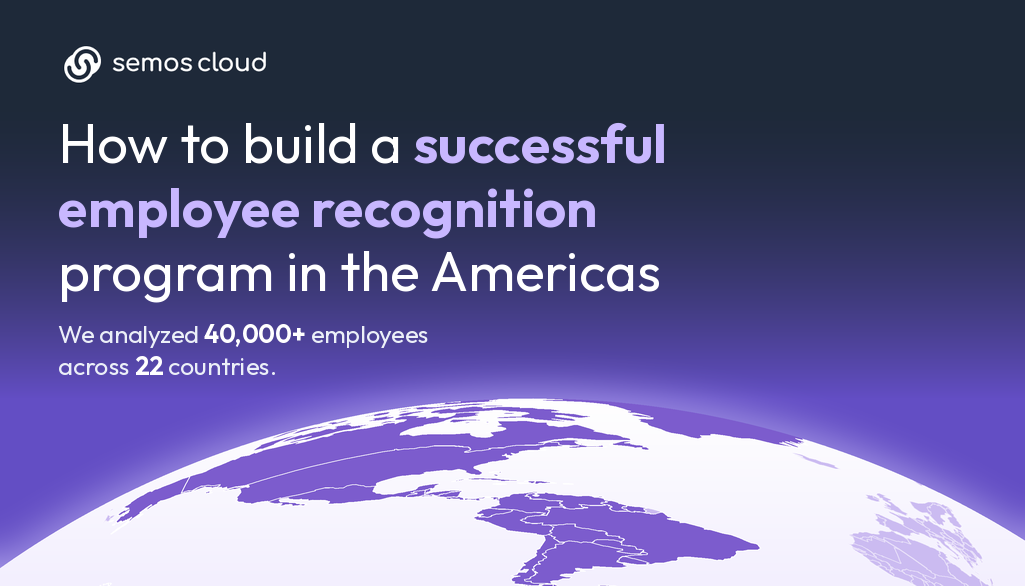
Building a successful global recognition program means looking at the full picture: recognition volume, who is participating, the balance between manager and peer recognition, access for frontline employees, and how recognition behaviors vary across cultures and markets. Keeping these factors in mind helps HR build a program that can scale while still fitting the needs of different employee groups and local contexts.
Companies in the Americas show strong recognition volume, with patterns that vary significantly by market.
We looked at recognition data from over 40,000 employees across four global companies, spanning 2 to 22 countries each, covering organizations in manufacturing, consumer goods, and petrochemicals. The 40,000+ employees represent the combined sample across these four deployments, which include different geographic footprints, industries, and workforce compositions.
The most US-based program recorded 6.5 awards per employee per year, illustrating how recognition can become deeply embedded in workplace culture. But volume is only one part of the picture. Recognition habits are shaped by culture, workforce composition, and how programs are designed. Participation tells us more about how broadly recognition is embedded. In the US-based program, 21% to 29% of employees sent recognition, pointing to an opportunity to bring recognition into the everyday experience of more employees.
The Americas paradox: strong recognition volume and broad participation are two different dimensions of recognition culture. Understanding both helps organizations design programs that work across different markets.
.png)
Who this article is for
- HR and total rewards leaders running recognition in the US, Canada, or Latin America
- Global program owners who use US numbers as their benchmark
- Anyone whose recognition dashboard looks healthy but whose engagement scores do not match
Why recognition comes so easily in the Americas
Researcher Geert Hofstede scored countries on how people behave at work. Three of his scores matter for recognition. The US scores high on all three in ways that help.
Individualism: 91 out of 100. One of the highest in the world. In the US, praising one person in front of the group is normal. Nobody finds it awkward. In much of Asia, it can embarrass the person you are praising.
Uncertainty avoidance: 46. Low. US employees try new tools without waiting for the boss to go first. This is a big advantage. You only notice it when you launch somewhere that does not have it.
Power distance: 40. Medium. People feel free to praise a colleague, not just their own team.
Three practical things help too:
- HR budgets are mature. SHRM suggests spending about 1% of payroll on recognition, which gives leaders a number to defend.
- Everyone works in one language. Writing a thank-you note is easy.
- Most recognition software was designed in and for this market.
So 6.5 awards per employee is not proof of a better program. It is proof that the program and the culture want the same thing.
For context, our benchmark framework expects 3 to 5+ awards per employee for US consumer goods companies. Americas manufacturing sits at 1.5 to 2.5.
The three challenges behind recognition volume
1. Participation is concentrated - High recognition volume can come from a relatively small group of employees. Looking at who sends recognition helps organizations understand whether recognition is becoming an everyday habit across the workforce.
2. Recognition can lose meaning at scale - When recognition becomes frequent and effortless, messages can become generic. The opportunity is to make recognition specific and meaningful, so higher volume doesn’t come at the expense of quality.
3. Access and rewards shape participation - Recognition only works when employees can easily participate and the rewards are relevant to them. Deskless employees may need different access points, while reward options should reflect the preferences and needs of the workforce.
[cta]
How to run a recognition program in the Americas
The Americas gives you one big advantage. You do not have to wait for leaders to go first.
In countries like Japan and Poland, the order is fixed. Executives endorse it, then managers cascade it, then campaigns run, then peers join in. Skip a step there and nothing happens. In the US you can run all of this at once.
Use that freedom on reach. Here are six moves, strongest first.
1. Pick your headline metric before launch.
Put unique sender rate over the last 90 days at the top of your report. Unique sender rate is the percentage of employees who sent at least one recognition during the last 90 days. It tells you how broadly recognition participation is distributed across your workforce.
This matters more than it sounds. A program grows whatever it reports. Report volume, and you may get more volume from the same small group. Track unique senders, and you can see whether recognition is reaching more employees across the organization.
2. Use managers to start the behavior, not to carry it.
Aim for 60% or more of managers sending regularly. In our deployments, that lifts peer-to-peer sending by about 22% in 90 days.
Then watch the split. If manager-sent recognition keeps growing and peer-sent stays flat, you are building the concentrated program you were trying to avoid. It will look like success for about a year.
3. Ask for specifics from day one.
Require a value or behavior tag on every recognition. Aim for 60% of recognitions tied to a company value. Adding this later is much harder, because you are changing a habit instead of building one.
4. Fix frontline access before you scale.
Use kiosks on the factory floor. Send SMS alerts. Let managers send on behalf of people without devices. Keep physical boards next to the app. Every month a group is left out, the program's habits form without them.
5. Check redemption every quarter.
Treat it as a measure of whether people value the rewards. If redemption falls while sending holds steady, your catalog has drifted. In a diverse workforce, that drift is usually regional.
6. Benchmark against similar companies.
Compare yourself to companies with a similar country mix, industry, and program age. Comparing a 20-country program to a US-only program invents a failure that is not there.
One thing not to do: do not run campaigns that push for more recognition. Volume is already easy here. A volume push gets you more sending from the same few people. It improves the number you were already winning and hurts the one you were not.
Sun Communities rebuilt its recognition program around everyday participation and saw a 175% increase in employee engagement. Read the Sun Communities story.
[cta-2]
What Mexico already proves
The best example is in the same region. We studied a two-country petrochemical company based mainly in Mexico. Its program generates 2.5 awards for every employee on the system each year. That is under 40% of the US program's volume.
Its sender rate is 47%. That is the highest in the whole study, and nearly double the US program.
Lower volume. Almost twice the reach.
This is not a criticism of the US program. It shows that volume and reach are two separate dials. Three things got Mexico there:
- Families and communities are included in celebrations, so more people take part
- Warm peer culture makes appreciation feel normal, not formal
- Reward values match local buying power instead of a converted US figure
None of those are technology choices. All three are design choices any company in the Americas can make.
How Semos Cloud helps
Reach is a design problem, and it is the one we build for.
Our recognition and rewards platform reports unique sender rate as a core metric, not a hidden one. It is built for deskless and frontline teams, with mobile access, manager-proxy sending, and kiosk options. Reward catalogs are localized for 170+ countries with point values that reflect local buying power. And it runs inside SAP SuccessFactors, Workday, and Oracle HCM, so recognition sits where people already work.
Across our enterprise customers, that shows up as 24% lower voluntary turnover among employees actively engaged in recognition, 42% higher manager effectiveness scores, and 3.5x average ROI within 12 months.
Hubbell, the US electrical manufacturer, focused on connecting a global workforce:
"We greatly appreciate the Semos Cloud team for helping us bring Hubbell's culture of recognition to life... you've made it possible for our employees to feel valued and connected across the globe."
- Garth Warner, VP Human Resources, Hubbell
Find more client success stories in our Customer Hub.
What the Americas can teach your global program
The recognition practices that work in the Americas can translate globally: peer-to-peer recognition, manager spot awards, nomination cycles, and service milestones. What varies is how employees engage with them across different cultures and workforces.
In Japan, employees may look to leaders to set the example before participating. In China, team-based recognition can be more comfortable than singling out individuals publicly. In Romania, manager-led recognition can be a natural part of the culture.
The platform can stay the same. The approach should adapt.
Employee recognition metrics to track
Four numbers can help HR understand whether recognition is reaching the right people and working across different employee groups:
- Unique sender rate over the last 90 days - This measures the percentage of employees who sent at least one recognition during the last 90 days. Look for whether participation is broadening across the workforce or whether recognition is still coming from a small, consistent group of employees.
- Cross-border recognition - If you operate across multiple countries, look at how often recognition is sent across country or location boundaries. This can show whether recognition is connecting distributed teams or staying mostly within local teams and offices.
- Recognition volume by culture group - Look at recognition patterns across culture groups rather than region alone. Compare both participation and volume to identify where recognition behaviors differ and whether certain groups may need a different approach to drive participation.
- Manager participation - Track how much recognition comes from managers compared with peers, and how many managers are actively participating. A high volume of peer recognition with limited manager participation, for example, may point to an opportunity to strengthen manager-led recognition.
Together, these metrics give you a clearer view of how recognition is taking hold across your workforce, beyond volume alone.
Want the full study? It covers all four companies, the benchmark framework by peer group, and the four-level global recognition maturity model. Read The Global Employee Recognition Paradox.
Book a demo to see how Semos Cloud can help you build a recognition program that drives meaningful participation across your workforce.


Explore related articles
.avif)
.avif)
%20(1).png)
Ready to unify your people programs?
Stop running recognition, rewards, communications, and development in silos. See how Semos Cloud brings it all together in one AI-powered platform, built for enterprise, certified for compliance, and proven at scale.