


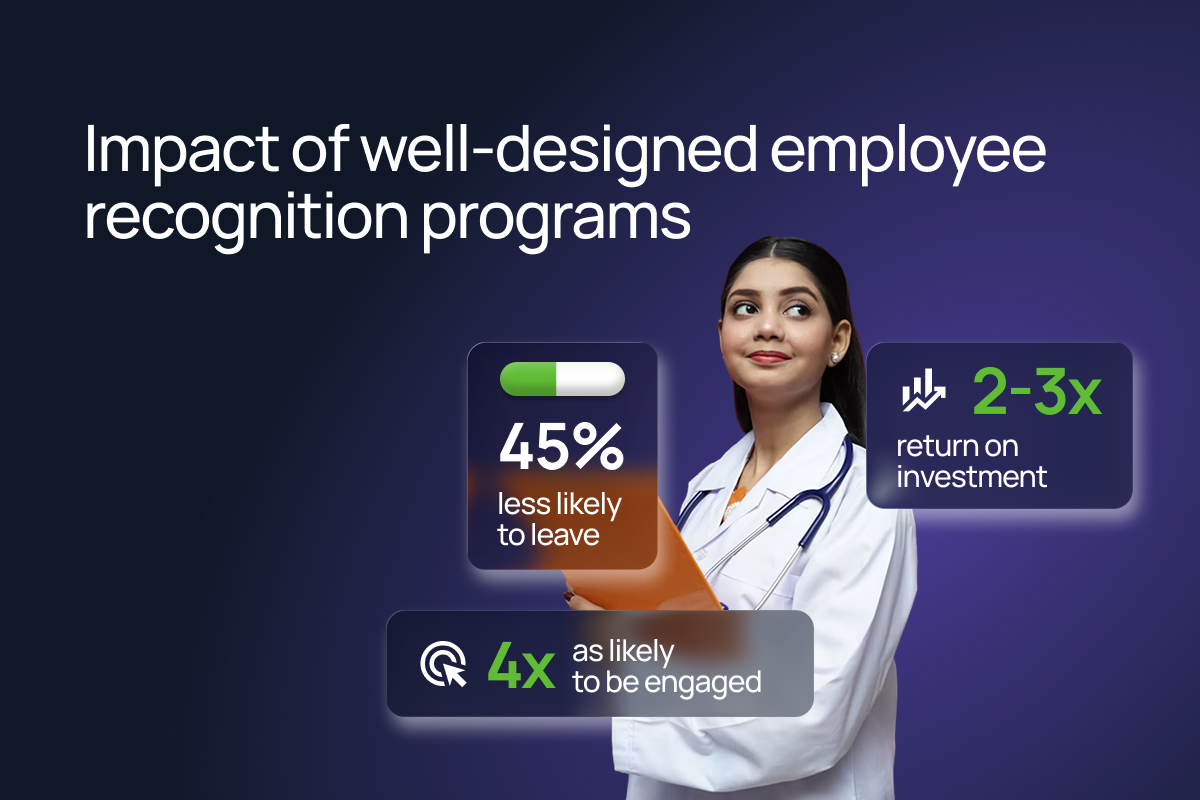
- Recognition is proven to improve retention and engagement, which makes it one of the easiest HR programs to justify to Finance.
- Those results come from high-quality recognition, and that needs a planned budget, not leftover spend.
- A dedicated budget line makes recognition visible, fair across teams and harder to cut.
- Start from a benchmark for your company size, not last year's number.
- Decide the funding model, approval rules and regional approach before you set the total.
Introduction
If you're reading this in Q4, your 2027 HR budget is probably already taking shape. Headcount plans, learning programs, benefits renewals and technology all compete for the same approval meeting.
Employee recognition often ends up as an afterthought in that conversation. It gets folded into an engagement budget, funded from whatever is left over, or copied from last year's number.
That's a missed opportunity. Recognition is one of the few people programs that works every day of the year, not only at review time. When it has a clear budget and clear rules, it becomes part of how your organization operates. When it doesn't, it stays a nice idea that managers use when they remember to.
This article covers what recognition delivers, why that makes it worth its own line item in 2027, and what to think through before you put a number on it.
What employee recognition delivers: the proof
Before talking about how much to spend, it helps to be clear about what the investment buys. The research points in one direction.
People stay longer. A Gallup study followed nearly 3,500 employees from 2022 to 2024. Employees who received high-quality recognition were 45% less likely to have left their job two years later.
People are more engaged. Earlier Gallup research found that employees who feel fulfilled by the recognition they receive are up to four times as likely to be engaged at work.
Managers become the multiplier. Gallup research shows managers account for most of the variation in team engagement. Giving managers a recognition budget and clear rules puts that influence to work every day.
Stress goes down. Recognition doesn't change the workload, but it changes how people experience it. Employees who feel appreciated report feeling less stressed, which protects performance during busy periods. We look at this research more closely in Analyst spotlight: The human reality behind work in 2026.
The program pays back. Well-designed enterprise recognition programs consistently deliver two to three times their investment, mostly through avoided turnover and stronger engagement.
.png)
Turnover is where this becomes a Finance conversation. Replacing an employee costs a significant share of their annual salary once you add recruiting, onboarding and lost productivity. Even a small reduction in voluntary turnover across a large workforce often covers the cost of the entire recognition program.
What it looks like in practice. SAP reached an 85% employee engagement rate with its recognition program, running one experience across a global workforce. Sun Communities used a new recognition program to recreate its company culture and saw engagement increase by 175%. You'll find more results like these in our customers hub.
From proof to budget
There's an important detail in that research: the results come from high-quality recognition. That means recognition that is frequent, fair, meaningful and built into how work gets done. Occasional, ad hoc appreciation doesn't produce the same outcomes.
High-quality recognition doesn't happen by accident. It needs a budget that lets managers and peers act in the moment, rules that make awards feel fair, and enough investment that recognition feels real rather than symbolic. That's why the business case and the budget belong in the same conversation.
Why recognition needs its own budget line
Most organizations already spend money on recognition. The problem is that the spend is scattered. A team lunch here, a gift card there, a service award managed by a different department, a nomination program funded from a regional budget.
Scattered spend creates three problems:
- It's invisible. Nobody can say what the organization actually invests in recognition, so nobody can say whether it's working.
- It's uneven. Employees in one team or country get recognized generously, while others with the same contribution get very little.
- It's hard to defend. When budgets get tight, spend that isn't tied to a program or a goal is the first to be cut.
A dedicated recognition budget fixes all three. It makes the investment visible, gives every employee access to the same program, and turns recognition from a discretionary expense into a planned one.
[cta]
What happens when you don't plan for it
Organizations that skip the planning step usually run into the same issues within the first year:
- Managers hesitate to recognize people because they don't know what they're allowed to give.
- Larger awards get approved case by case, which feels arbitrary to the people who don't receive them.
- Finance sees costs appear across multiple budgets and asks for the program to be paused or reviewed.
- Rules get added after the first unusual award, which erodes trust in the whole program.
None of these are hard to avoid. They just need to be decided before launch, not after. For what comes next, read Beyond go-live: what makes recognition programs transformative.
What to have in mind for your 2027 recognition budget
1. Start from a benchmark, not last year's number
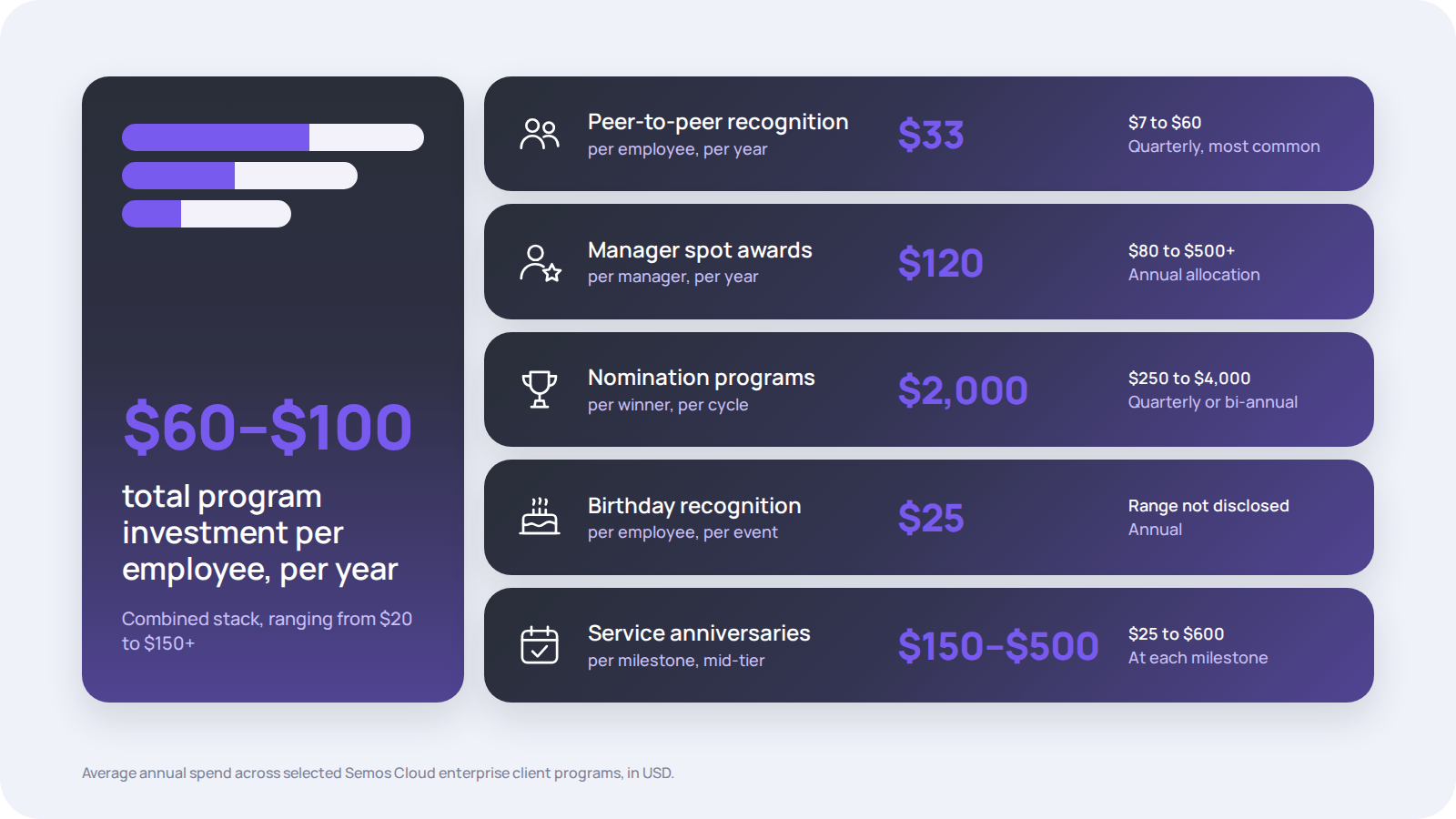
Last year's spend tells you what happened, not what your program needs. A better starting point is what comparable organizations invest, adjusted for your size. Larger workforces typically invest less per employee while still running a substantial total program, so compare yourself to organizations of a similar size rather than an overall average.
2. Build layers, not a single program
No single program type carries recognition on its own. Peer-to-peer recognition creates frequency. Manager awards add momentum. Nominations and service milestones add meaning. Plan a budget for each layer so one doesn't quietly absorb the others.
3. Choose the funding model before the number
The most useful question isn't "how much?" but "when does the money leave the budget?" It can come from a shared pool, be deducted the moment someone sends a recognition, or be committed only once an award is approved. Each option changes how fast recognition moves and how much oversight Finance has, so it's worth deciding first.
4. Set approval rules before launch
Everyday awards should be easy to give, with no approval at all. Higher-value awards need a clear, visible approval path and someone accountable for the decision. Agree on where those thresholds sit before the program goes live, so managers know what they can do on their own.
5. Plan for regions from the start
If you operate in more than one country, expect award values, currencies and timing to vary. What should stay consistent is the structure: the same layers, the same funding logic and the same approval principles. Localize the details, not the model. For a regional example, see what meaningful employee appreciation looks like in the Middle East.
6. Check it against payroll
A share of payroll is a useful sense check once you've built the budget from the bottom up. Think of it in cumulative tiers: basic programs first, then celebration and manager programs, then peer-to-peer monetary recognition once adoption is proven.
A quick checklist before you meet with Finance
☐ Which recognition programs will run in 2027, and who can use each one?
☐ How is each program funded: shared pool, on send or on approval?
☐ Where do approval thresholds sit, and who approves?
☐ How will the budget differ by country or region?
☐ How does the total compare to organizations of a similar size?
☐ How will you report on usage and impact during the year?
If you can answer these, your budget conversation becomes a discussion about outcomes rather than a negotiation over a number. To choose the right measures, see Strategic HR metrics and the recognition reality gap.
Plan your 2027 recognition budget with confidence
Our Recognition Budget Sampler brings these decisions together in one place: benchmarks by program type and company size, regional comparisons, funding models and real enterprise configurations you can use as a reference.


Explore related articles
.avif)
.avif)
Ready to unify your people programs?
Stop running recognition, rewards, communications, and development in silos. See how Semos Cloud brings it all together in one AI-powered platform, built for enterprise, certified for compliance, and proven at scale.