The myth vs reality read goes deeper



Key insights at a glance
- Autonomy is real, and outcomes are the new scoreboard. Around 200 SAP agents are generally available today, yet SAP itself says the real story is not how many agents are switched on, but the business outcomes they deliver.
- The debate is about speed, not direction. No expert we spoke with dismissed a claim as a pure myth. Their reservations were about scope, speed and who stays accountable, never about where HR is heading.
- Governance is the one unanimous reality. Every expert who took the topic called it a reality, and 42% of SAP Connect’s virtual audience named trust and governance the biggest barrier to AI agents. For one analyst, it is already HR’s biggest challenge.
- Context beats the model. Connected people data is the clearest marker of HR tech maturity. Most organizations still run recognition, listening, feedback and communications apart from the HCM, which leaves agents without the context they need.
- Autonomy is earned, process by process. Structured, high-volume work can move first. Anything that decides pay, careers or someone’s standing at work should stay with a person, supported by better information.
- HR has been handed the redesign of work, and has to claim it. Executives name HR the owner of redesigning work, yet most say the capacity automation creates is not being redeployed. Whether HR is ready depends on whether its leaders step in first.
- Managers are where AI becomes employee impact. The value of AI in HR shows up when managers get timely context about their team, not another dashboard.
Introduction
AI agents are now generally available inside the HR systems most enterprises already run. At SAP Connect 2026, SAP put autonomous HR on the main stage and handed HR a clear mandate: automate the operational work, redesign how work gets done, and reinvent how people are hired, developed, moved, measured and rewarded.
The pressure to act is real, and so is the risk of acting too fast. Gartner predicts that over 40% of agentic AI projects will be canceled by the end of 2027, because of rising costs, unclear business value or weak risk controls. McKinsey finds that 62% of organizations are experimenting with AI agents, yet no more than 10% are scaling them in any single business function. And in Mercer’s Global Talent Trends 2026, executives name redesigning work around AI as their top people priority for return on investment.
This report helps HR leaders separate what is ready to act on from what is still ahead of reality. It brings together the biggest learnings from SAP Connect 2026, the views of leading HR tech experts from Mercer, The Josh Bersin Company, Brandon Hall Group and others, and the approach Semos Cloud is taking to make autonomous HR deliver outcomes, not just more agents.
What you will take away
• A clear read on which autonomous HR claims are reality today, and which are still a promise.
• How automate, redesign and reinvent translate into decisions HR owns.
• What leading experts say HR teams are underestimating, from governance to connected people data.
• Five practical moves you can start in the next quarter.
Who this report is for
CHROs, HRIT and HRIS leaders, and the people and culture, total rewards and employee experience leaders in SAP SuccessFactors environments who are being asked what autonomous HR means for their organization.
SAP Connect 2026’s defining themes, through the eyes of leading experts
SAP Connect 2026 made autonomy real. We read it through the question HR leaders are actually asking: what is myth, and what is reality? To answer it, we spoke with leading voices in HR technology: Steve Hunt of i3 Talent and ASTA Advisors, Steve Goldberg of SBG Consulting HR Tech Advisory, Tara Cooper of Mercer, Kathi Enderes of The Josh Bersin Company, independent HR tech analyst and advisor Tami Nutt, PJ Jakovljevic of Technology Evaluation Centers, Jon Reed of diginomica, and David Forry of Brandon Hall Group. Their views run through every theme that follows, in their own words.
Why SAP is building toward autonomous HR
SAP Connect 2026, five months after Sapphire, carried one message: the autonomous enterprise is no longer a preview. Assistants and agents are generally available, Joule Work is rolling out to every customer, and customers took the stage to show results. Yet in the same sessions, SAP and its customers described autonomy as a trust journey, built on context and governance, with people accountable for outcomes. To understand what that means for HR, it helps to start with why SAP is building in this direction at all. Read all about it in the event recap blogpost.
Business change has become workforce change
SAP SuccessFactors opened its HCM keynote with a story from the CHRO of a global consumer brand. AI had changed how her customers discover and choose products, moving discovery online and changing the role of physical stores. New growth opportunities followed, but capturing them required new skills and capabilities across the entire workforce. What began as a shift in consumer behavior became a workforce challenge. SAP’s point was that this is no longer the exception: across industries, every change in the business now arrives as a change in the workforce.
SAP SuccessFactors’ Future of Work Research Lab described what that looks like. People are moving from deep specialization to applying their expertise across a wider range of problems. Static jobs are giving way to dynamic roles whose responsibilities change as fast as the business does. And success is increasingly measured by impact rather than output. Organizations are not just adopting new technology; they are rethinking basic assumptions about how work gets done and how value is created.
The capacity gap
The research also showed how far most organizations are from that shift. HR spends nearly two thirds of its capacity on operational work. 72% of executives say organizations claiming to transform work with AI are mostly automating existing jobs faster. And while AI is already giving HR teams time back, 65% say that capacity is not being strategically redeployed. The questions that follow, how work should change, how roles should evolve, which skills will be needed and how to prepare people for what comes next, are business questions, not technology ones. 88% of executives say redesigning work and roles creates significant enterprise value, and they rank HR as the number one owner of that work. The wider market agrees. Deloitte’s 2026 Global Human Capital Trends finds that organizations which intentionally redesign roles, workflows and decision-making are more likely to exceed expectations on their AI investments.
Why autonomy, and why SAP
SAP’s answer is the autonomous enterprise, and its argument rests on where it already sits. SAP says 99% of the world’s 100 largest companies are its customers, and its systems run the processes that connect HR to finance, supply chain and procurement. That lets it bring together industry knowledge, connected business processes, trusted data and AI, with people firmly in control. The logic is that nothing in a business runs in isolation: workforce planning is not separate from finance, and skills are not separate from operations.
Autonomous HCM is that idea applied to people. As SAP SuccessFactors described it, AI automates end-to-end processes, supports context-aware decisions and optimizes the workforce at scale, so the system adapts to the business rather than the other way around and every workforce decision is informed by the full picture of people and strategy. SAP was candid that a powerful model is not enough to get there. Outcomes require context: process knowledge, trusted data, governance and an understanding of what the data means. That is why it announced its intent to acquire TechWolf, whose skills intelligence shows what people can actually do right now, based on the work they are doing, benchmarked against more than 2 billion live labor market signals.
SAP also described how the customer conversation itself has changed. Early on, the questions were about tasks: what can an agent do, what can an assistant automate. Today the question is how AI can help achieve a business outcome, and SAP says that shift now shapes its innovation strategy.
“People are and will always be the heartbeat of an organization, and that is where autonomous HCM comes in.”
- Siva Sundarasan, SAP SuccessFactors (SAP SuccessFactors HCM keynote)
Automate, redesign, reinvent
To make autonomous HCM practical, SAP SuccessFactors set out three connected areas where HR can lead. SAP presents them as a path, but stresses that they are linked rather than separate projects. Each was shown live on stage with Joule.
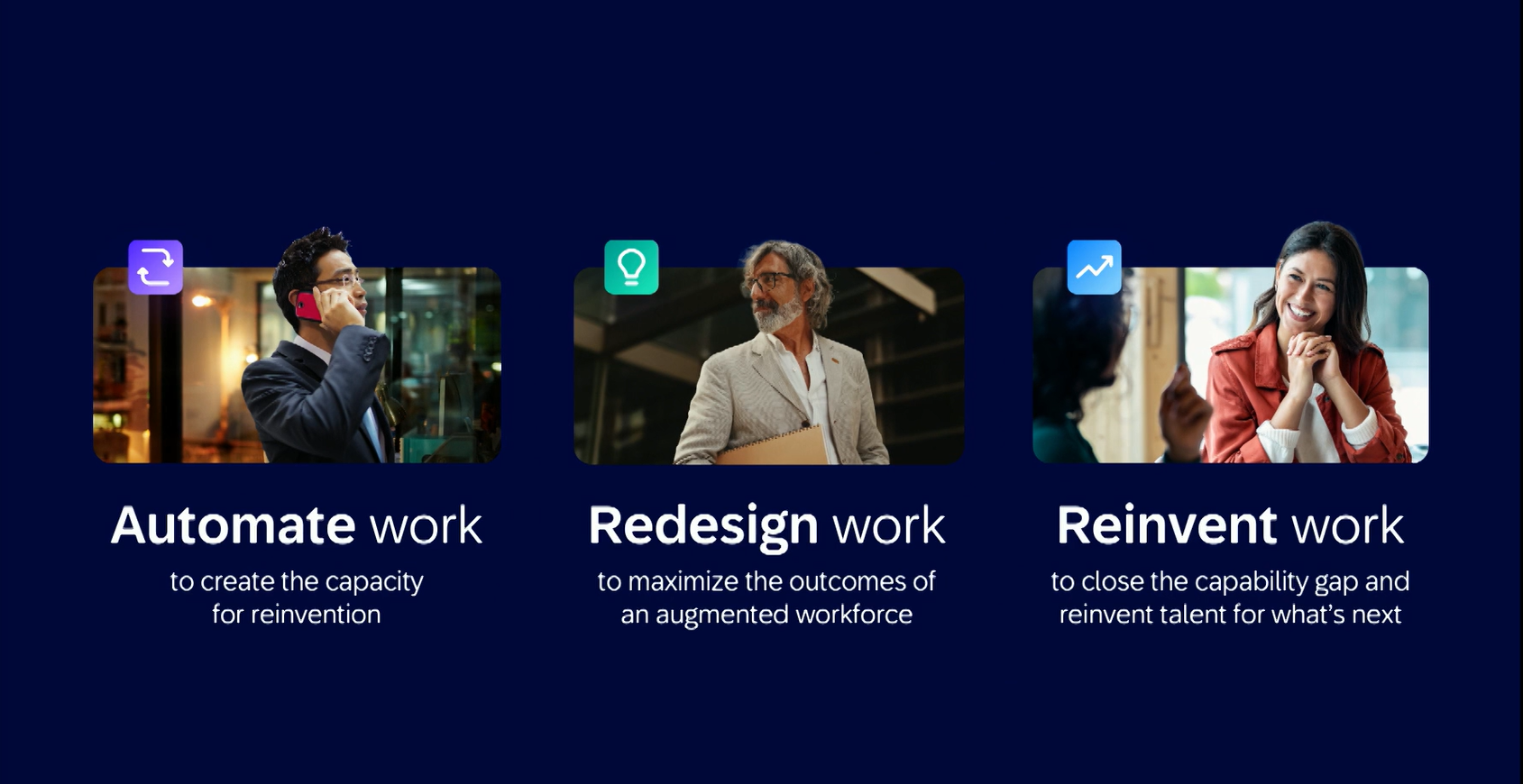
Step 1: Automate
The goal: free HR teams from the operational work that consumes their capacity.
Automation is executives’ number one near-term priority, and the reason is simple. Payroll, service delivery, workforce management and recruiting take up most of HR’s time, and much of it can be automated. Every hour freed from operational work is an hour that can go to strategy and to people. On stage, Joule surfaced every unresolved US payroll issue in seconds, traced the first one to its root cause, a missing state tax code, and recommended the fix. In SAP’s words, automation is where the journey begins.
Step 2: Redesign
The goal: rethink tasks, roles and teams around the new business reality.
For decades, organizations optimized fixed jobs, roles and processes, and AI challenges every assumption those models were built on. The question is no longer only efficiency, but which work belongs to AI and which belongs to people. SAP framed this as a business transformation question and increasingly one of HR’s most important responsibilities. The demo showed Joule reviewing a messy skills library, recommending what to add, rename and keep, then checking the job architecture for missing skills and asking for approval before making changes. People still make the decisions; the agent does the tedious work.
Step 3: Reinvent
The goal: transform how people are hired, developed, moved, measured and rewarded.
Careers, learning, performance, rewards and mobility were built for a world of stable jobs and predictable career paths. As AI takes on more work and skills change faster, SAP argued that these processes cannot simply be improved; they have to be rebuilt around outcomes rather than activities, capabilities rather than tenure, and what comes next rather than what came before. The question shifts from developing people for the roles you have to continuously preparing them for work that keeps changing. The demo put this in a manager’s hands: Joule found the skill gaps on a team, assigned learning, and built a personal leadership journey around the manager’s time, goals and confidence.
Why the three steps belong together
Automation without redesign creates capacity nobody uses. Redesign without reinvention changes job descriptions without changing how people grow, move and are rewarded. SAP’s five co-innovation customers, IBM, John Deere, SAP, Swiss Re and Wipro, will help connect the three journeys over the next eight months. The experts we spoke with add a useful challenge: rather than a strict sequence, the three steps may work best as a flywheel, with redesign starting before every process has been automated.
For people and culture teams, the third step matters most. Reinvent explicitly includes how people are rewarded and recognized, and those are the moments where employees feel whether the changes around them are working. That is where the signals Semos Cloud captures come in.
“They will create capacity where others are creating complexity. They will redesign work instead of automating inefficiencies. They will build capabilities faster than the pace of change. And they will connect workforce decision directly to business outcomes.”
- Siva Sundarasan, General Manager and Chief Product Officer, SAP SuccessFactors (SAP SuccessFactors HCM keynote)
What the experts heard at Connect
Before we asked a single myth or reality question, we asked the experts what stood out. Their answers set the tone for everything that follows: the conversation at Connect was not only about technology, but about what happens to work and the people doing it.
Tara Cooper of Mercer noticed that SAP led with the workforce, not the technology:
“I found it to being redibly interesting that our day actually led with research around what's happening to the workforce itself when we implement this technology. Itshouldn't just be what to build but what shouldn't we build how should we build who should we bring into that conversation"
- Tara Cooper, HR Tech Analyst, Mercer
On automate, redesign, reinvent, she sees the harder work ahead in the second and third steps:
“Because most organizations were not built for this sort of thing, so we have to start to build that muscle of rethinking, reinvention, redesign. The automation piece, I think, is more obvious to most organizations.”
- Tara Cooper, HR Tech Analyst, Mercer
Kathi Enderes of The Josh Bersin Company welcomed the move beyond efficiency:
“I just love that it’s no longer just about automating what we already have, but it’s about redesigning the work and reinventing how roles and how work actually happens.”
- Kathi Enderes, SVP Research, The Josh Bersin Company
Tami Nutt, independent HR tech analyst and advisor, sees each step doing a different job:
“The initial piece of automation is where you get the quick wins. It frees up some of the time and space we need to think about the bigger changes. Reinventing work and business processes doesn't happen quickly. But I think reinvention is where we’ll see the greatest long-term impact, where businesses and people will really feel the difference. Technology can help people unlock their strengths, contribute in more meaningful ways, and feel more empowered in the work they do.”
- Tami Nutt, Independent HR tech analyst and advisor; formerly VP Research and Insights, Jumpstart HR
How Semos Cloud approaches all three
SAP’s three steps are not only a message for customers. Semos Cloud is applying them to its own platform, rebuilding its solutions and architecture around agents and Semos IQ, the intelligence layer that powers more than 24 Semos Cloud agents. As CEO Filip Misovski explained - every company is now going through a cycle of not just automation, but rethinking, redesigning and reinventing work, and Semos Cloud is doing the same.
Automate: the analysis happens in the background. Semos IQ’s process agents read across SuccessFactors, organizational, payroll, recognition and communication data, and even meetings and one-on-ones, and turn it into signals automatically. Instead of being buried in reports and analysis, HR gets that work done without needing data analysts or AI engineers.
Redesign: signals come to people, not the other way around. Instead of HR pulling reports, a signal reaches the right person, an employee, a manager or an HR business partner, with a recommended action and the reason behind it. People can ask follow-up questions before they act.
“These signals are very important because they’re proactive way to nudge an employee, a manager, HR business partner to take action, and justify the action.”
- Filip Misovski, CEO, Semos Cloud
Reinvent: a more proactive relationship with HR systems. Semos IQ agents are listed in SAP Discovery Center alongside SAP’s own agents, where Semos Cloud is among the first HCM partners, and they are available natively in Joule and Joule Work. Employees, managers and HR leaders work with their people data in the flow of work, in a way that is more proactive and more engaging than before.
The outcome: from buried reports to timely action. Filip was clear that technology alone is not the point; the next step for the industry is to drive outcomes. In practice, that means managers acting on a signal in the week it appears rather than after a quarterly review, HR seeing which programs actually change behavior, and recognition becoming governed data that informs decisions on culture and rewards. Deloitte shows what that looks like at scale: a recognition hub for more than 200,000 professionals, connected to SAP Business Data Cloud.
SAP’s autonomous enterprise, as presented at Connect
Behind the three steps sits a new architecture for how enterprise work gets done.
- Joule Work as the single engagement layer: conversations, spaces and Joule Studio.
- Knowledge Graph as the context map: more than 7 million data fields.
- SAP Business AI Platform as the place to build, contextualize and govern agents.
- Agent-to-agent gateway as the connector to SAP and third-party agents.
- Autonomous Suite as the direction of operations, HCM among five domains.
- AI Agent Hub as one inventory for every SAP and non-SAP agent.
- TechWolf as the context graph for work, skills and labor signals.
- Human in and on the loop as the control model for decisions that matter.
For HR leaders this is more than a platform story. The same keynotes handed HR the redesign of work, named HCM a high-risk AI domain, and put judgment and accountability beyond what AI should decide.
Autonomy is real. What isn’t yet real for most HR teams is the connected data and the governance that let it scale safely.
SAP builds the foundation. Semos Cloud adds the signal layer
SAP provides the foundation: SuccessFactors stays the system of record for core HCM, and SAP’s Business AI Platform, Joule and agents run the processes on top of it. Semos Cloud adds what that foundation does not capture on its own: the people-and-culture signals around recognition, communications, listening, feedback, rewards, benefits and manager behavior. Semos IQ, Semos Cloud’s intelligence layer, surfaces those signals in the flow of work, activates the right agent, and leaves the final decision with a person. Because Semos Cloud is built natively on SAP BTP, all of this runs inside the same governance model as the SAP landscape it serves.
How Semos IQ works alongside SAP: the loop, end to end
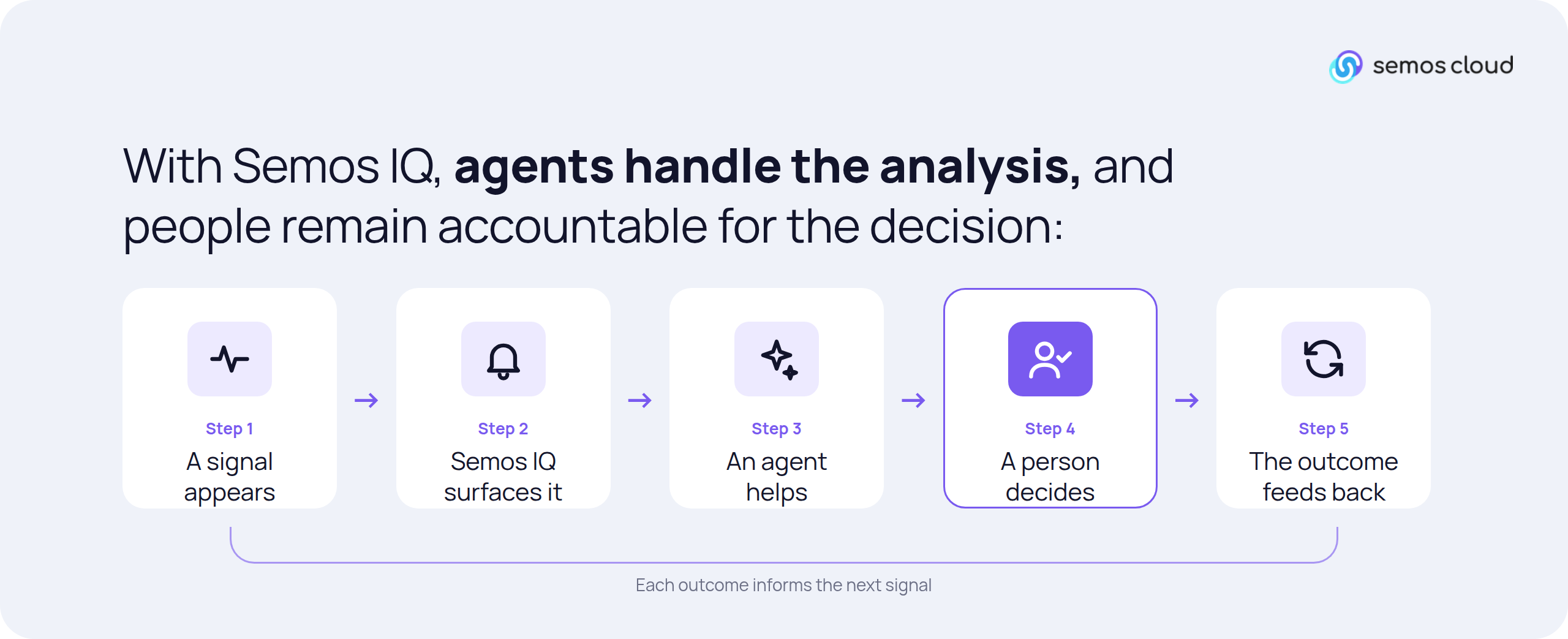
A signal appears. Something changes in a team: recognition drops, survey sentiment dips, or a strong performer has not been recognized in months. The signal comes from Semos Cloud and SuccessFactors data.
Semos IQ surfaces it. Semos IQ spots the signal and brings it to the right person, a manager or HR business partner, in the flow of work, in Semos IQ or in Joule.
An agent helps. A Semos IQ agent interprets the signal and drafts a recommendation, a message or a recognition.
A person decides. The manager or HR business partner reviews, edits, approves or completes the action. Nothing happens without them.
The outcome feeds back. What the person did becomes new data, which sharpens the next signal.
This follows the human-in-the-loop approach SAP described at Connect: the agent does the legwork, and a person makes the call.
Autonomy is here, and outcomes are the scoreboard
What we heard at Connect
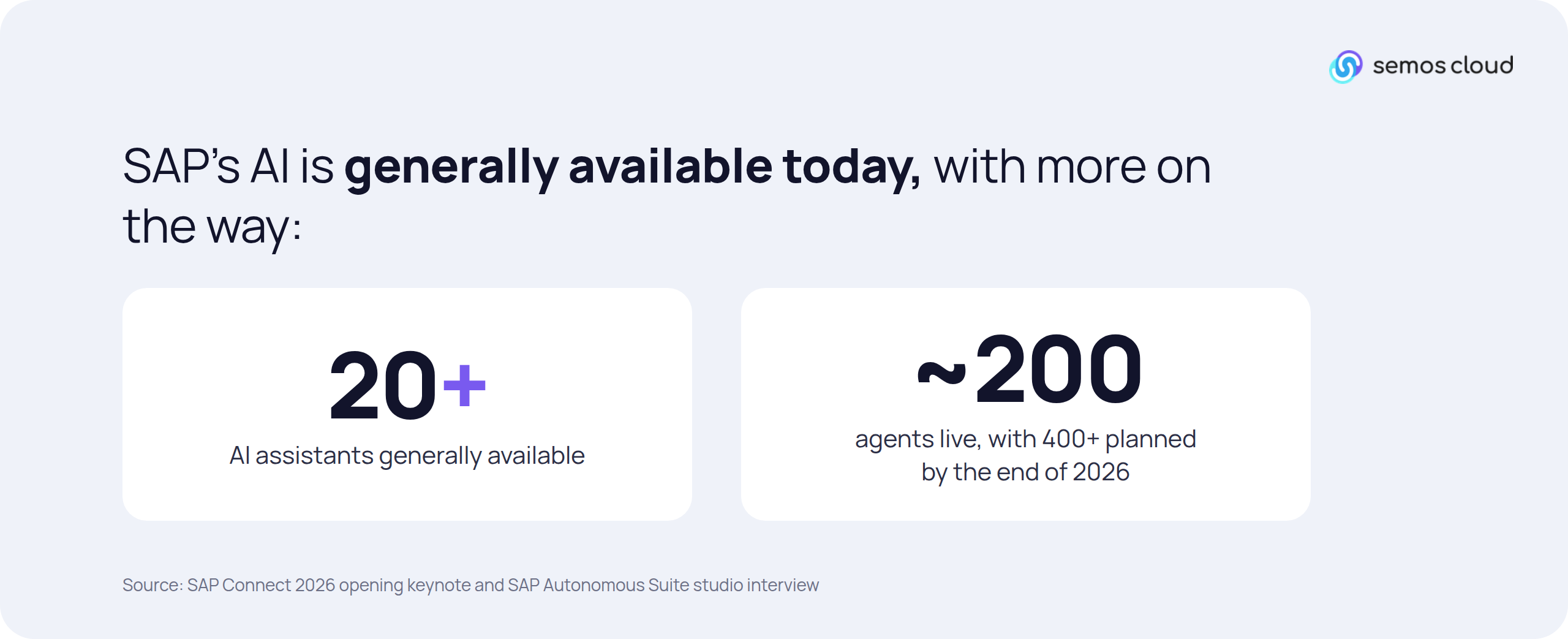
More than 20 assistants and around 200 agents are generally available, with 400+ targeted by the end of 2026. Joule Work is rolling out to every customer as the single place to ask, delegate and get work done, and SAP reports productivity gains of over 20% in HR, finance and procurement among its own 110,000 employees. Yet the most quotable moment from the CEO was a warning against counting agents at all.
“But the real story isn't the number of agents. It's the business outcome they deliver for you, our customers.”
- Christian Klein, CEO, SAP (SAP Connect 2026 opening keynote)
What the experts say
Every expert we spoke with agreed that AI agents will change how HR operates. None of them treats the change as automatic. Tami Nutt put the condition most sharply: if companies treat AI only as a way to increase speed and cut headcount and cost, the promise will not be realized; if they use it to connect information, the workforce and the business, it can be. Kathi Enderes added a warning about where most organizations are today: agents are now so easy to build that they multiply, but they rarely work together yet. The wider market backs this up. McKinsey finds that no more than 10% of organizations are scaling AI agents in any single function, and Gartner expects over 40% of agentic AI projects to be canceled by the end of 2027 for lack of clear value.
In their own words
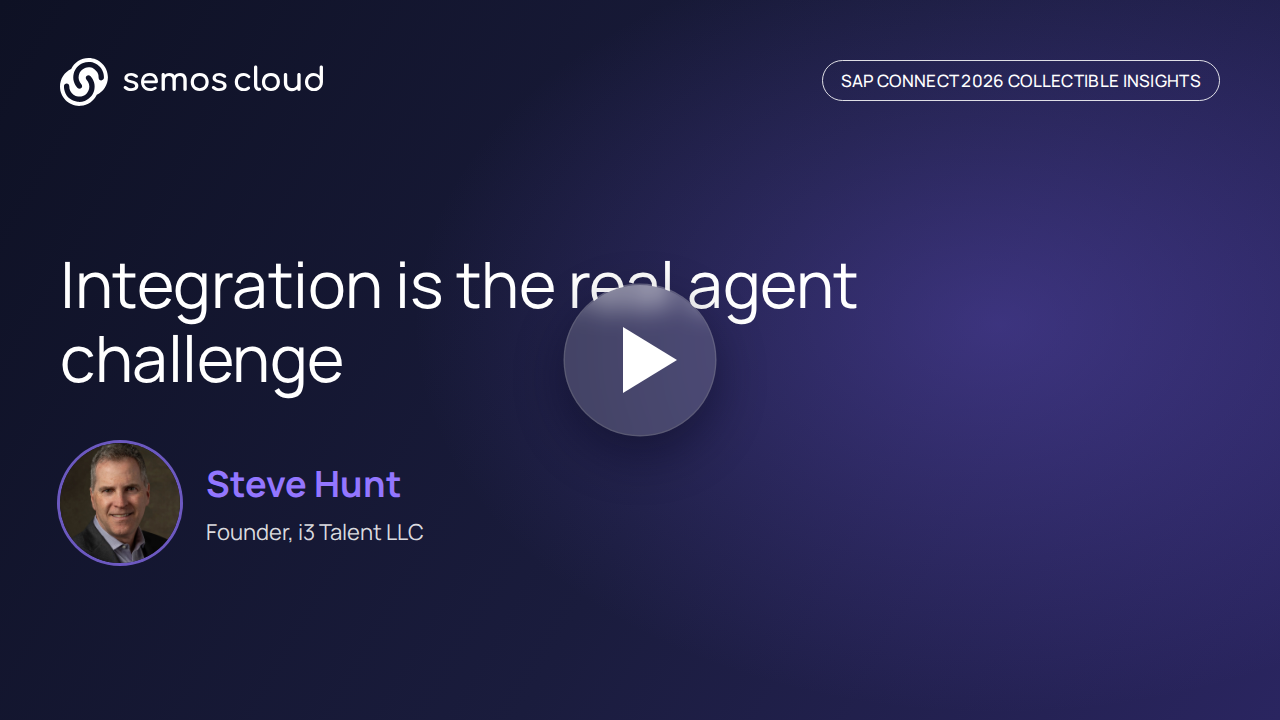
Steve Hunt, who spent years inside SAP as Chief Expert for Technology and Work, sees the transformation as certain and the path as the open question. His first test for any agent is whether it can reach the data it needs.
Verdict: “for sure”
“The question is like, how do I see these agents? What I'm starting to see is what makes an agent really? Well, one, it has to have access to data and often we don't have data or access to data to do things we want to do. And sometimes this data is located in multiple places. So integration is such a huge challenge in using agents. And so there's a lot of distance to go on that.” |
- Steve Hunt, i3 Talent; partner, ASTA Advisors
Hunt expects a mix of in-house builds and off-the-shelf agents from HR tech vendors, shaped by what each vendor does best.
Tami Nutt, who brings a law degree in labor and employment law to HR technology, set out the condition under which the promise holds.
Verdict: “It depends”
“It really depends on if companies approach it as a system change that is only focused on increasing speed, reducing head count, reducing costs. If that's the sole approach, then that promise is not going to be a reality. But the companies that look at connecting information, connecting the workforce, connecting the different areas of the business with HR and utilizing AI to do that and to build that bigger, deeper picture for each of the employees and their work and how it all works together, then that can be a reality.”
- Tami Nutt, Independent HR tech analyst and advisor; formerly VP Research and Insights, Jumpstart HR
Predrag PJ Jakovljevic sees agents absorbing the high-volume administrative work while the human core of HR stays with people.
Verdict: “Almost a reality”
“AI has been handling tasks from candidate sourcing and onboarding to drafting performance reviews and answering a vast majority of routine policy questions. Rather than eliminating the HR profession entirely, AI agents are redefining the HR roles to focus on high-value human connections and strategic business growth. For example, complex conflict resolution, trust-building, executive coaching, leadership development, and organizational culture remain for the humans.”
- Predrag PJ Jakovljevic, Principal Analyst, Technology Evaluation Centers
Kathi Enderes, whose HR 2030 research frames HR as a dynamic enabler for growth, is bullish on AI, and equally clear that the transformation has to be designed rather than switched on.
Verdict: “absolutely yes, but it won't be automatic.”
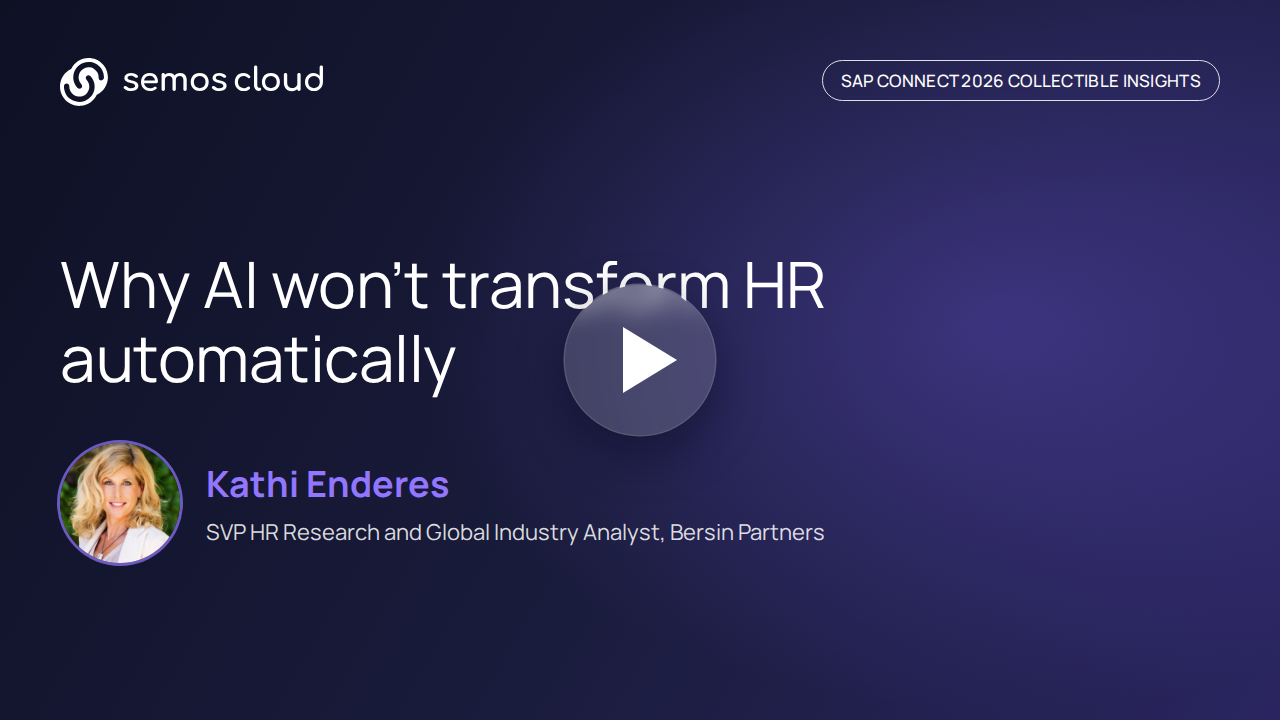
“Well, that's the big promise of HR 2030, and so we believe absolutely yes, but it won't be automatic. It's not just because you use AI, that automatically will transform your function from the service function to what we call a dynamic enabler for growth. So we have to work on reinventing and redesigning, reimagining what HR actually is and what we do in HR and what value we provide as well. That's why I also love when they're talking about value and outcomes now here at SAP Connect as well. So that outcome focus is really key. We call this falling in love with the problem, not falling in love with the solution.”
- Kathi Enderes, SVP Research, The Josh Bersin Company
On what the organizations getting it right do differently:
“They don't just look for the AI and say, oh, here's a hammer and everything looks like a nail, kind of thing, but they don't start with the AI, they start with the value that they want to create, and then they're back into, how can the AI help me for that? So I think that mindset shift is really key.”
- Kathi Enderes, SVP Research, The Josh Bersin Company
“But there has to be orchestration of the agents just like there's orchestration of the people. And it's not just that each one has a specific responsibility, but that they can collaborate together. That's orchestration.”
- Steve Goldberg, SBG Consulting HR Tech Advisory
What it means for HR
The question HR leaders should bring to every vendor conversation, and to their own leadership, has changed. It is no longer how many agents are switched on, but which outcome each one moves, who owns that outcome, and how anyone will know it worked. Agent counts no longer differentiate. What matters is whether an agent reasons from the right people data, recognition, listening, feedback and SuccessFactors alike, and whether it runs where HR teams already work, inside SAP and Joule.
What to do next quarter
List the agents already running in HR, including those employees built themselves, and write down the outcome each one is meant to move. Any agent without an outcome is a pilot, not a transformation.
Context beats the model
What we heard at Connect
Christian Klein opened with the unicorn he drew at Sapphire, whose extra ear made the point for him. SAP described a knowledge graph mapping more than 7 million data fields, and SAP SuccessFactors announced its intent to acquire TechWolf, a context graph for work benchmarked against more than 2 billion live labor market signals. Nestlé tied its AI ambitions to a harmonized digital core across more than 140 countries.
“A powerful model is not enough. Business outcomes require something more fundamental. They require context.”
- Siva Sundarasan, SAP SuccessFactors (SAP SuccessFactors HCM keynote)
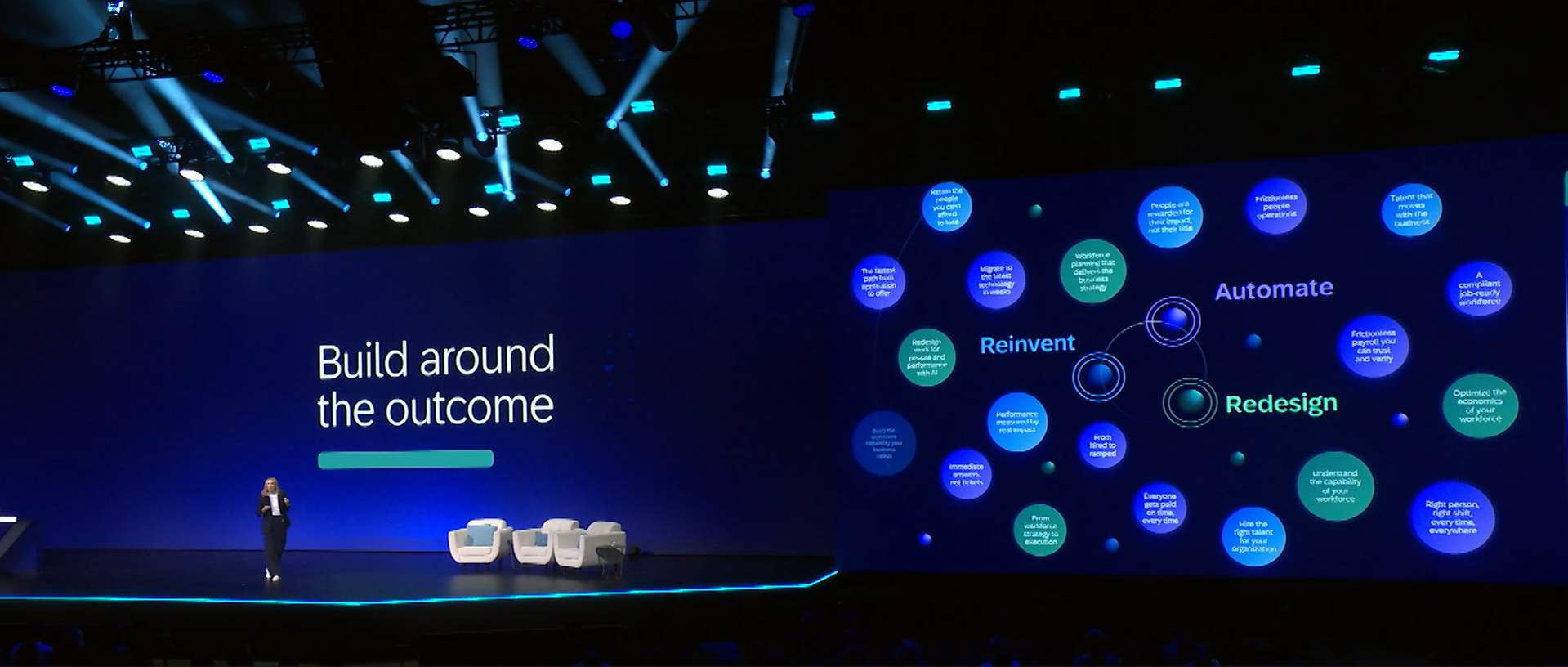
SAP SuccessFactors identified 20 outcomes, written the way customers describe them, such as everyone being paid correctly and on time. A concept demo took a production target through are designed workforce plan, internal mobility, hiring, pay and learning in one flow, and an agent-to-agent gateway now connects SAP agents with third-party agents.
“Now, most redesigns don't fail in the decision. They fail in the months after it.”
- Rebecca Carr, SAP SuccessFactors (SAP SuccessFactors HCM keynote)
What the experts say
The experts largely agree that connected people data is the clearest marker of HR tech maturity, and that the value of context and signal now outweighs the value of automating a process. David Forry of Brandon Hall Group added an important caution: the operating model decides how much value the data delivers. Brandon Hall Group’s research finds that 46% of organizations remain in the first two phases of AI maturity, despite the growing availability of sophisticated technology.
In their own words
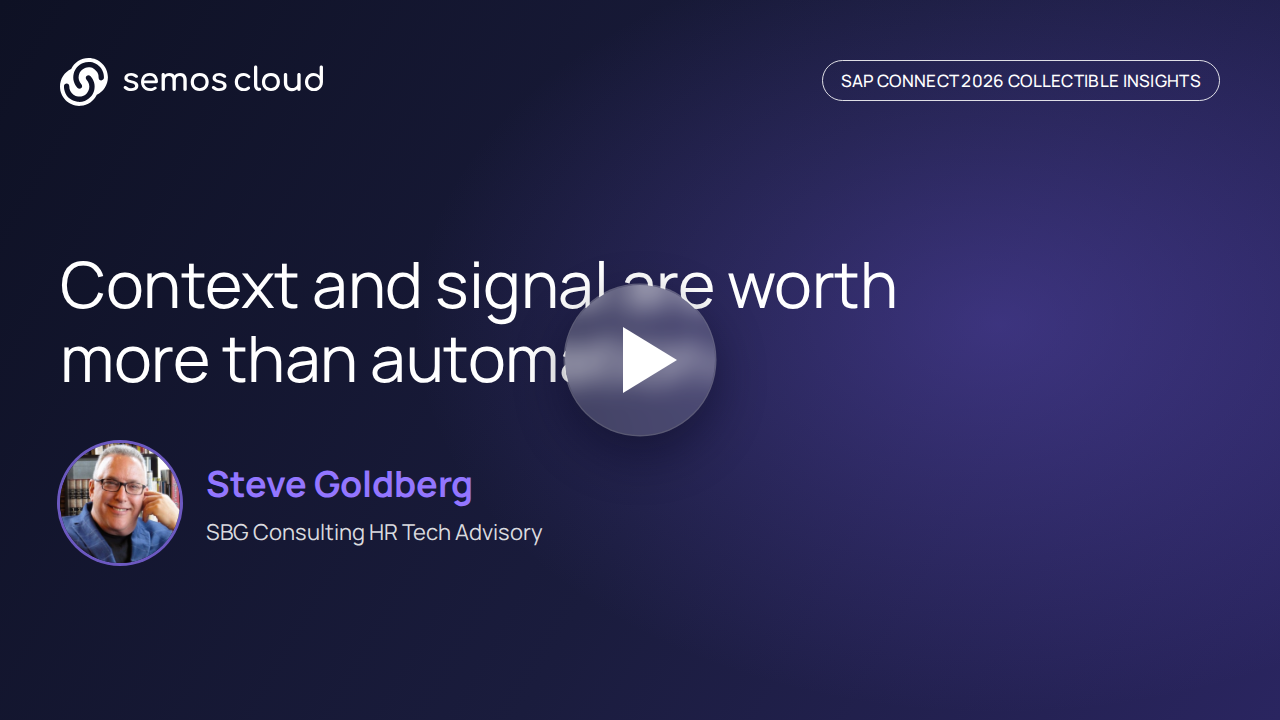
Steve Goldberg, who led HCM product strategy at PeopleSoft, frames HR technology as a three-tier value pyramid, and places data, context and signal at the center of what matters now.
Verdict: “I think it is reality for sure.”
“Now we're talking about how do you leverage data as a real asset in conjunction with AI agents that can look at the depth of data you have ... as it’s the depth and the relevance of data that is really the context. What you can infer from the data that can lead to a recommendation, that's the signal. Data context and related signals to me are much more valuable than foundational automation of the process."
- Steve Goldberg, SBG Consulting HR Tech Advisory
Tara Cooper’s own research on AI readiness backs the claim, and she sees SAP’s move on data silos as the encouraging sign.
Verdict: “I think that's a reality. In fact, my own research shows this.”
“So instead of kind of starting with the end in mind and then backing into the technology that supports that, we've gone out and bought a lot of shiny objects because they were shiny and fun and great. And now we're having a lot of problems inside of organizations connecting those together to make the experience work, to make the data work. And that's one of the things I found really exciting about this conference is SAP talking about tearing down their own data silos, right, people data, being able to talk to finance data.”
- Tara Cooper, HR Tech Analyst, Mercer
David Forry agrees, with a caution drawn from Brandon Hall Group’s AI Progression Model.
Verdict: “REALITY, but connected data is only part of the equation.”
“Our research shows that 46% of organizations remain in the first two phases of AI maturity, despite the growing availability of sophisticated technology. Brandon Hall Group's AI Progression Model examines maturity across people, processes, technology, organizational readiness and governance. Connecting workforce data is essential, but the real progression happens when organizations can use that intelligence to improve decisions, redesign workflows and deliver measurable business outcomes. Technology creates the opportunity. The operating model determines how much value an organization can actually realize.”
- David Forry, SVP and Principal Analyst, Brandon Hall Group
Predrag PJ Jakovljevic describes what connected maturity looks like in practice.
Verdict: “A reality”
“Most organizations use separate platforms for recruiting, payroll, performance, and learning. True maturity happens when these systems talk to each other, allowing HR leaders to see how hiring sources impact long-term performance or retention. Basic HR tech tells you what happened (e.g., turnover rates). Connected data and context tells you why it happened and who is likely to leave next, allowing for proactive actions. Moreover, when the people data is tied to financial and operational metrics, HR transitions from a cost center to a strategic driver.”
- Predrag PJ Jakovljevic, Principal Analyst, Technology Evaluation Centers
What it means for HR
People data is where guessing carries the most risk. An agent that recommends a pay adjustment, flags attrition or suggests a promotion is only as good as the context behind it, and in most organizations that context is spread across the HCM, recognition, surveys, feedback and communications tools that do not talk to each other. Bringing those signals together with SuccessFactors data is what lets a risk surface while there is still time to act, long before it shows up as turnover.
At SAP Connect 2026, Deloitte showed how connecting recognition to SAP Business Data Cloud turns it into governed data for decisions on culture and rewards, across more than 200,000 professionals.
What to do next quarter
Name three people decisions you can’t make well today because the data sits in separate systems. Those three decisions are your integration roadmap, and a better test of maturity than any feature list. To put a number on what disconnected tools cost you, try our Cost of Fragmentation Calculator.
Autonomy is earned, and governance is the operating model
What we heard at Connect
SAP’s Autonomous Suite leadership set out four stages: human in the loop, human on the loop, human control without compromise, and learning in the loop. SAP’s Chief Security Officer described oversight calibrated to risk, ending with human in command for high-risk decisions. And SAP SuccessFactors asked five co-innovation customers, IBM, John Deere, SAP, Swiss Re and Wipro, to prove connected agents over eight months before broad rollout.
“They don't see this as an overnight shift that where they can draw the line to say, starting tomorrow, I'm going to become autonomous. Nobody can say that.”
- Manoj Swaminathan, President and Chief Product Officer, SAP Autonomous Suite (SAP Connect virtual studio, day two)
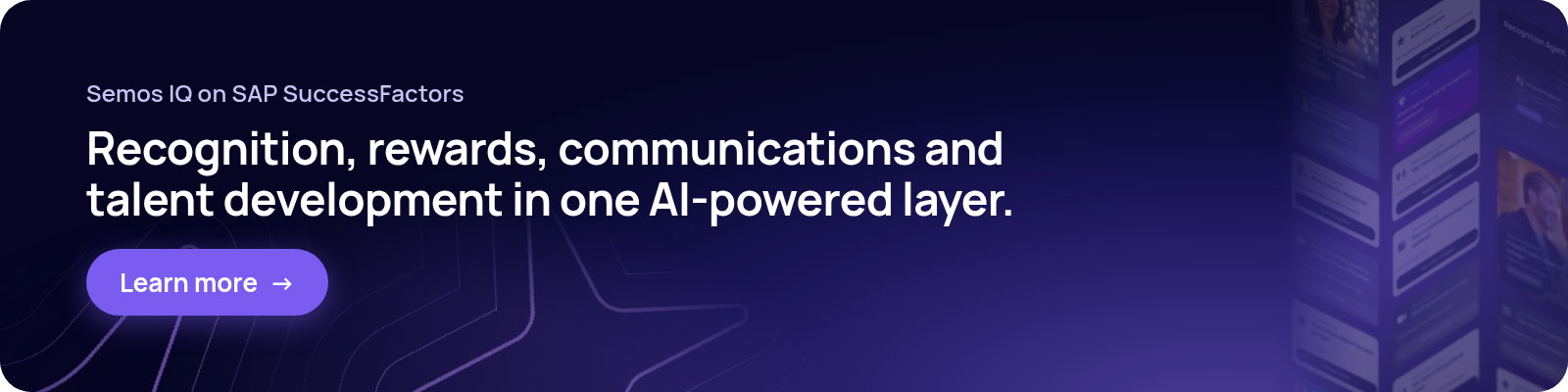
SAP’s Chief Security Officer told the main stage that 83% of enterprises use AI daily but only 13% have true visibility of what it is doing. Every SAP agent now gets a verified owner, a risk tier and scoped access before production, under ISO 42001. In a separate interview, the same speaker placed HCM in the high-risk tier, calling for a risk assessment per use case, a human with oversight, a full audit trail and regulatory mapping from day one. The virtual audience agreed: 42% named trust and governance the biggest barrier to AI agents.
“Who owns this AI decision? Who can see what it is doing right now? And who can stop it?”
- Marielle Ehrmann, SAP Chief Security Officer, SAP (SAP Connect 2026 opening keynote)
What the experts say
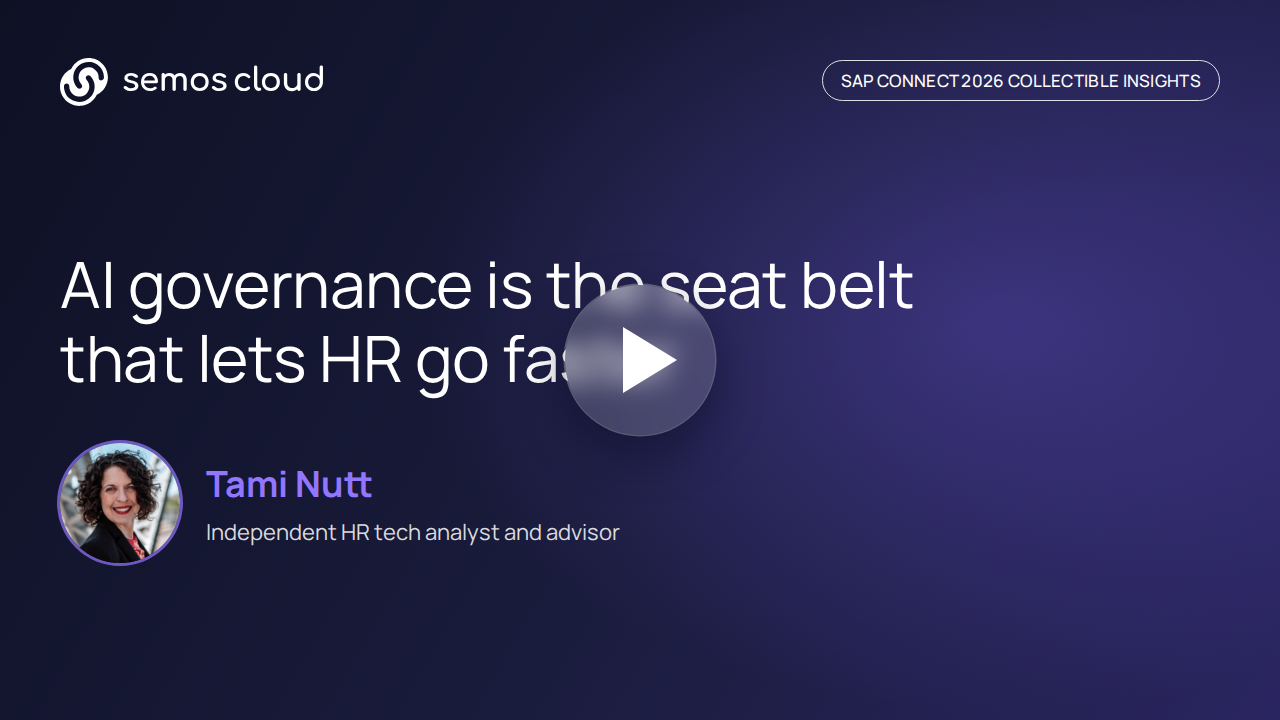
Autonomy was the most confident claim on SAP’s stage and the most contested one in our conversations. Some experts see autonomy for routine, high-volume HR work as already real; others limit it to the simplest tasks, or warn that the real fantasy is believing HR will need far fewer people. On governance, there was no debate. It was the one topic where every expert who took it called it a reality, and Tami Nutt went further: governance is already HR’s biggest challenge, and the answer is not to lock everything down. Like seat belts in cars, good guardrails are what let a business go faster.
In their own words
Predrag PJ Jakovljevic sees human-in-the-loop automation as already the norm for structured work, with people keeping the judgment calls.
Verdict: “Already a reality”
“Already a reality where the HR software handles routine, high-volume tasks, allowing humans to step in primarily for exceptions, complex decision-making, or strategic oversight. This operational model is known as "Human-in-the-Loop" (HITL) automation. Autonomous processes thrive in areas with structured data and predictable rules like high-volume recruiting, employee onboarding, routine employee support, core payroll & benefits, etc. HR depts still need humans for bias and fairness, empathy and workplace nuance/culture, and ascertaining any legal risks.”
- Predrag PJ Jakovljevic, Principal Analyst, Technology Evaluation Centers
David Forry draws on Brandon Hall Group’s research on the AI-enabled HR operating model, and uses recognition to show where the line sits.
Verdict: “REALITY, with an important distinction.”
“Many HR processes will become increasingly autonomous, but the bigger transformation is how organizations redesign work around AI. Our research on the AI-Enabled HR Operating Model reinforces the importance of clearly defined decision rights, governance and human capabilities as automation expands. Employee recognition is a great example. AI can identify contributions that are being overlooked and help managers deliver more meaningful recognition, but the human connection should remain. The opportunity is to automate the work surrounding those important moments so people have more time to focus on what matters.”
- David Forry, SVP and Principal Analyst, Brandon Hall Group
Jon Reed sees both sides: more autonomy than many expected, and a dangerous fantasy about how few people HR will need.
Verdict: “I think it's a myth and a reality.”
“I think it's a myth and a reality. It's a reality that some processes will be able to run autonomously, including processes that we didn't think would ever be autonomous (like applicant screening and preliminary interviews). However, some processes HR managers think they can run autonomously are going to face legal and regulatory challenges. Where the myth comes in is the fantasy that we don't need a lot of humans working in HR. We will.”
- Jon Reed, Co-founder, diginomica
Tami Nutt, trained in labor and employment law, was the most emphatic voice on governance, and the most practical about what to do with it.
Verdict: “It is already HR's biggest challenge.”
“I always relate it to seat belts. When cars were first created, they didn’t have seat belts, so speed limits helped reduce the risk. The faster you were going when you hit something, the farther you could go flying, and that’s a problem when you’re dealing with people. But as the auto industry evolved and regulations introduced safety measures like seat belts, we could increase speed limits because we had mitigated some of that risk and put guardrails in place. That’s really what compliance and governance around AI can do for businesses. They create the guardrails that allow organizations to move faster while managing the risks.”
- Tami Nutt, Independent HR tech analyst and advisor; formerly VP Research and Insights, Jumpstart HR
On what HR teams are underestimating most:
“It’s not what you know people are doing. It’s what you don’t know they’re doing that is the biggest risk. And so, figuring out a way to get your hands around that and put some things in place that allow you to govern it, so that unmanaged piece doesn’t become a compliance risk.”
- Tami Nutt, Independent HR tech analyst and advisor; formerly VP Research and Insights, Jumpstart HR
Steve Hunt sees governance as the visible part of a bigger change: what it means to do a job well when AI is everywhere.
Verdict: “It will become a major challenge”
“So I think it's going to be governance on the data thing. But I also think it's fundamentally going to change talent management. What is a high performer in an AI saturated world versus what is a high performer in a non AI saturated world? It's different because you need to use AI, but not over rely on AI. And I think that's going to be really of how the nature of what makes somebody effective in a role is going to change.”
- Steve Hunt, i3 Talent; partner, ASTA Advisors
Jon Reed adds risk management to governance, pointing to HR processes that fall under the EU AI Act’s high-risk guidelines, and to the chance to redesign rather than just automate.
Verdict: “Well that's certainly a reality”
“But "explaining" why you illegally screened out a certain class of applicant isn't going to be enough in a court of law. Yes, governance is a must as agents scale. One of the biggest myths in agentic AI is that automation alone is where the impact and ROI is. HR is a great example of areas where inserting/keeping humans in, at just the right place in the process, can make all the difference, and still achieve a good level of ROI.”
- Jon Reed, Co-founder, diginomica
Predrag PJ Jakovljevic points to how far policy lags practice.
Verdict: “must be a reality”
“AI governance and guardrails must be a reality, if they are not at the moment. More than half of organizations deploy or pilot AI without a formal policy, and a vast majority of existing guidelines lack clear, future-proof standards like explain ability on who/what (bot or agent) made a decision and why. A cross-functional coordination involving HR, legal, IT, and strategy to define explicit decision rights is a must.”
- Predrag PJ Jakovljevic, Principal Analyst, Technology Evaluation Centers
“The agent is not going to tell you the level or degree of confidence in what it's recommending. It'll just recommend based on whatever data it has, and it won't tell you when it doesn't have enough data for you to confidently draw inferences.”
- Steve Goldberg, SBG Consulting HR Tech Advisory
What it means for HR
The useful question is not whether to go autonomous, but which processes have earned it. Structured, high-volume, low-risk work can move first. Anything that decides pay, careers or someone’s standing at work should stay with a person, supported by better information. Before any people agent goes live, security, legal and employee representatives will ask HR the same three questions: who owns it, what can it see, and who can stop it. HR teams that arrive with the answers already written down will move faster, not slower.
What to do next quarter
Sort HR processes into three groups: structured and low-risk, sensitive or regulated, and relational. Then build an agent inventory with three columns: what data each agent can reach, who is accountable for its output, and how its access is revoked.
People, managers and judgment stay at the center
What we heard at Connect
SAP’s Chief People Officer shared three lessons from rolling out agents inside SAP: redesign the work before the agent, train people to work with AI, and build in access and decision rights from day one. In the HCM keynote’s rapid-fire round, judgment and agility were named the leadership skills that matter most, skill readiness and AI observability the most underrated HR metrics, and promotions and accountability the things AI should never decide.
“They can't replace judgment. And AI can't have judgment. People have judgment, and it comes from experience.”
- Steve Hankins, CFO, Morgan Foods (SAP Connect 2026 opening keynote)
What the experts say
Steve Goldberg, who has argued for line manager enablement for decades, calls the manager’s role a strong reality, with a nuance worth keeping: when people leave a manager, that manager may simply be overwhelmed, and that is context too. On whether HR is ready, Tara Cooper’s answer was that it depends. Most HR leaders see the impact coming; fewer know where to step in first and take accountability. Mercer’s Global Talent Trends 2026 shows why it matters: 82% of executives see HR’s future in managing human talent and digital agents side by side.
In their own words
Steve Goldberg has argued for line manager enablement since his HCM vision talks as head of strategy at PeopleSoft.
Verdict: “I feel very strongly that is, it is a reality.”
“It could be that the manager is overwhelmed themselves with too much responsibility and too much change going on in the organization, and therefore not able to be a good advocate for that employee, a good coach for that employee. Maybe the employee was expecting those things out of the manager and so they leave. This is exactly where context is important. Because if an employee hypothetically says, I'm leaving because I don't have a good relationship with my manager, I'm not getting what I want out of my manager, it could be because the manager themselves is totally overwhelmed. And that's a big part of the context.”
- Steve Goldberg, SBG Consulting HR Tech Advisory
His reminder for anyone designing manager tools: what counts as recognition differs from person to person, and the most lasting kind is a manager investing in someone’s career.
Tara Cooper gave the most nuanced answer of the conversations, and the most direct about what HR has to do next.
Verdict: “I think that depends.”
“Well, I think that depends. I think most HR leaders understand that there's going to be a huge impact. I think a lot of them don't understand where they need to jump in first to take accountability in that. And this is something that we see from employees as well. Employees don't necessarily see HR as a digital leader inside of their organization, but they really should.”
- Tara Cooper, HR Tech Analyst, Mercer
Tara Cooper also questioned whether automate, redesign, reinvent should run as a strict sequence.
“I think those are the right steps, but I do question if that is more of a flywheel, do we need to actually start some of that redesign and some of that rethinking of the work and not waste so much time automating things that are eventually going to go away.”
- Tara Cooper, HR Tech Analyst, Mercer
What it means for HR
AI does not take HR off the hook for the human moments. It raises the bar on them. Managers translate technology into employee impact only when the tools give them context about their team rather than another dashboard. The work ahead is helping managers show up better when it counts, with the right signal at moment, not handing those moments to a model.
What to do next quarter
Look at what a manager actually sees about their team today. If the answer is a quarterly dashboard, start with one signal they can act on this week, such as who hasn’t been recognized in 90 days.
What to do next: The next-quarter autonomous HR roadmap
Most of the conversation at SAP Connect described where autonomous HR is heading. Most organizations are not there yet. Brandon Hall Group’s research finds that46% of organizations remain in the first two phases of AI maturity, and it is the same gap we found in recognition: in The Global Employee Recognition Paradox, most companies were measuring early-stage programs against goals only the most mature organizations reach. Closing that gap does not start with more agents. It starts with five moves HR teams can make in the next quarter.
1. Inventory your agents and give each one an owner. Include the ones employees built themselves. Accountability can’t be delegated to the technology.
2. Map HR processes by risk before automating them. Separate structured, regulated and relational work so autonomy goes where it has been earned.
3. Name three decisions that need connected data. Let those decisions, not feature lists, set your integration roadmap.
4. Redesign alongside automation, not after it. Decide where freed capacity goes before it arrives, starting with one role family.
5. Give managers context, not more dashboards. One signal a manager can act on this week beats a quarterly report.
Want to know where your organization stands today? Our 2026 Guide to Maximizing SAP SuccessFactors includes a five-stage maturity model and a self-assessment.
The ultimate insight: autonomy is a journey, accountability is not delegated
No expert called a claim a pure myth: the debate is about speed, not direction. Governance is the one unanimous reality. And HR owns this, if it steps in, because the blockers to AI value are people issues and the data to solve them sits in HR.
“This is a business problem that gets solved through people. And that is an HR accountability.”
- Tara Cooper, HR Tech Analyst, Mercer
Contributors, methodology and sources
Contributors
• Steve Hunt, i3 Talent; partner, ASTA Advisors; formerly Chief Expert, Technology and Work, SAP
• Steve Goldberg, SBG Consulting HR Tech Advisory; formerly PeopleSoft HCM product strategy, Bersin, Ventana Research
• Tara Cooper, HR Tech Analyst, Mercer
• Kathi Enderes, SVP Research, The Josh Bersin Company
• Tami Nutt, Independent HR tech analyst and advisor; formerly VP Research and Insights, Jumpstart HR
• Predrag PJ Jakovljevic, Principal Analyst, Technology Evaluation Centers
• Jon Reed, Co-founder, diginomica
• David Forry, SVP and Principal Analyst, Brandon Hall Group
How we built this report
This report brings together two sources: the sessions that shaped the HR conversation at SAP Connect 2026, and the views of independent HR tech experts on the claims made there. The aim was not to summarize the event, but to draw out its biggest learnings, test them against outside expertise, and read the result through a People and Culture lens.
The key learnings draw on the opening keynote with SAP CEO Christian Klein, including its Autonomous Suite, customer and trust segments; the SAP SuccessFactors HCM keynote and its customer panel with IBM and SAP; the SAP Connect virtual studio interview with Manoj Swaminathan, President and Chief Product Officer of the SAP Autonomous Suite; and an interview with SAP’s Chief Security Officer on AI security and governance. All figures are SAP’s and its customers’, as presented on stage, together with the result of SAP Connect’s virtual audience poll.
Expert input was collected between October 1 and October 8, 2026. Steve Hunt and Steve Goldberg spoke with us in recorded video calls; Tara Cooper, Kathi Enderes and Tami Nutt in recorded conversations at the Semos Cloud booth at SAP Connect2026; and Predrag PJ Jakovljevic, Jon Reed and David Forry answered in writing. We chose the topics for each expert based on their research focus, and the verdict labels shown are their own words. The Semos Cloud perspective draws on an interview with CEO Filip Misovski, recorded at the Semos Cloud booth.
Every quote is reproduced verbatim from the recordings’ transcripts or from written answers as supplied, including original grammar and spelling. Nothing inside quotation marks has been edited, and each contributor approves their quotes before publication. The Semos Cloud point of view and the autonomous HR maturity model are our own interpretation, informed by the sessions and the experts’ views.
About Semos Cloud
Semos Cloud is a People and Culture Intelligence platform built natively on SAP BAIP, serving 2M+ active users across 150+ enterprise customers. It brings recognition and rewards, total rewards, employee communications and listening, and talent development together with Semos IQ, its AI-native intelligence layer, with native integrations for SAP SuccessFactors, Workday and Oracle HCM.
Closing: Bring it in-house
Bring People and Culture Intelligence into your autonomous HR journey.
Semos IQ helps HR teams and managers move from scattered signals to timely, governed action. Built natively on SAP BTP for enterprise HR running SAP-centered environments, Semos Cloud connects recognition, communications, feedback, listening, rewards and manager signals into one People and Culture Intelligence layer.
Want to see it in action first? Watch our Semos IQ webinars.
Ready to build recognition programs people actually use?
See how Semos Cloud helps enterprise HR teams launch, manage, and scale recognition and rewards programs from one connected platform.