


- Europe adopts employee recognition when it feels relevant and appropriate, not just exciting.
- Build GDPR, works council requirements, and award tax rules into the employee recognition program from the start.
- Use two different behavioral models on one employee recognition program instead of treating Europe as one market.
- Report by cultural cluster, with unique sender rate as a key measure.
- Use European hubs to connect employee recognition across countries and regions.
Introduction
European employees adopt recognition when it feels legitimate, not when it feels exciting. Programs that treat GDPR, works councils, and award tax as design inputs launch with credibility. Programs that run one "Europe" strategy average the UK and Romania and fit neither. The fix is two behavioral models on one platform, reporting by cultural cluster, and using European hubs to connect the rest of your global program.
Europe is not a slower version of the Americas. It is a different environment.
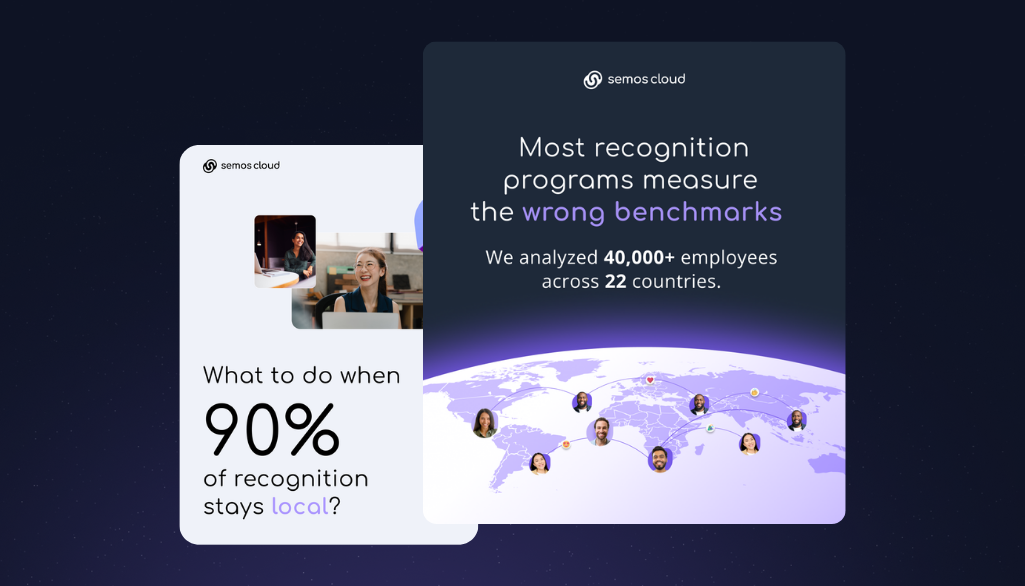
We looked at recognition data from over 40,000 employees across four global companies, spanning 2 to 22 countries each. In the largest deployment, a 22-country manufacturer, Europe made up 40% of the workforce.
Two things set Europe apart. It spans the widest cultural range of any region. And it is the only region where the law shapes a recognition program before culture does.
The Europe paradox: Europe has some of the strongest foundations for meaningful recognition anywhere. It also has the lowest employee engagement of any region in the world. The region best equipped to make recognition matter often gets the least from it.
Who this article is for
- HR and total rewards leaders running recognition across two or more European countries
- Global program owners who report "Europe" as a single number
- Teams preparing a launch in Germany or any market with works councils
Why Europe works differently
Researcher Geert Hofstede scored countries on how people tend to behave at work, on a scale from 0 to 100. In the US, the scores mostly point one way. In Europe, they point in every direction.
Three of his measures matter most for recognition:
- Individualism: how much people see themselves as individuals rather than part of a group. A high score makes peer-to-peer praise feel natural.
- Uncertainty avoidance: how much people want clear rules before they try something new. A high score means people wait for leaders to go first.
- Power distance: how much people accept a clear hierarchy. A high score means praise is expected to come from the manager.
Across the European countries we looked at, these scores fall into two broad patterns.
The UK, Germany, and Italy lean peer-to-peer. The UK scores 89 on individualism and just 35 on both uncertainty avoidance and power distance, so thanking a colleague comes naturally. Germany (67 on individualism) also leans peer-to-peer, but people like clear rules (65 on uncertainty avoidance). Italy (76 on individualism) leans peer-to-peer too, and recognition often picks up during campaigns.
Poland, Spain, and Romania lean on structure. Poland scores 93 on uncertainty avoidance, one of the highest anywhere, so people tend to wait for leaders and clear rules before they join in. Spain (86) follows a similar pattern: structure first, then peers join in. Romania scores 90 on both uncertainty avoidance and power distance and only 30 on individualism, so recognition feels right when it comes from the manager.
Source: Country scores come from Geert Hofstede's cultural dimensions model. How each pattern shapes recognition is our interpretation, based on these scores and the recognition data in our study.
The UK and Romania sit 59 points apart on individualism. That is a wider gap than anything inside APAC. In London, thanking a colleague in a public feed feels normal. In Bucharest, praise is expected to come from the manager first.
Europe also has a second layer the Americas rarely deals with. The law shapes the program before culture does.
- GDPR covers recognition data. Who praised whom, for what, and who can see it is all personal data under the General Data Protection Regulation. Public feeds need clear settings and a clear legal basis.
- Works councils have a say. In Germany, a works council has a legal right to approve any tool that can track how employees behave or perform (Works Constitution Act, Section 87). A recognition platform can fall under this rule, so plan for the council's agreement before launch.
- Award tax changes at every border. The same award can be taxed differently in each country you operate in.
So European employees do not adopt a program because it is exciting. They adopt it because it is legitimate. That means it is backed by employee representatives, clear about data, fair on tax, and launched by people they trust.
For context, our benchmark framework expects 1.5 to 3.0 awards per employee per year for European multinationals.
The paradox: strong foundations, modest results
Europe already has what most regions are still trying to build:
- Employee voice is built in. Works councils and employee representatives are part of how companies run.
- Employment relationships are high-trust. Long tenures and strong protections give recognition a stable base.
- People expect their data to be respected. That is exactly the kind of trust recognition depends on.
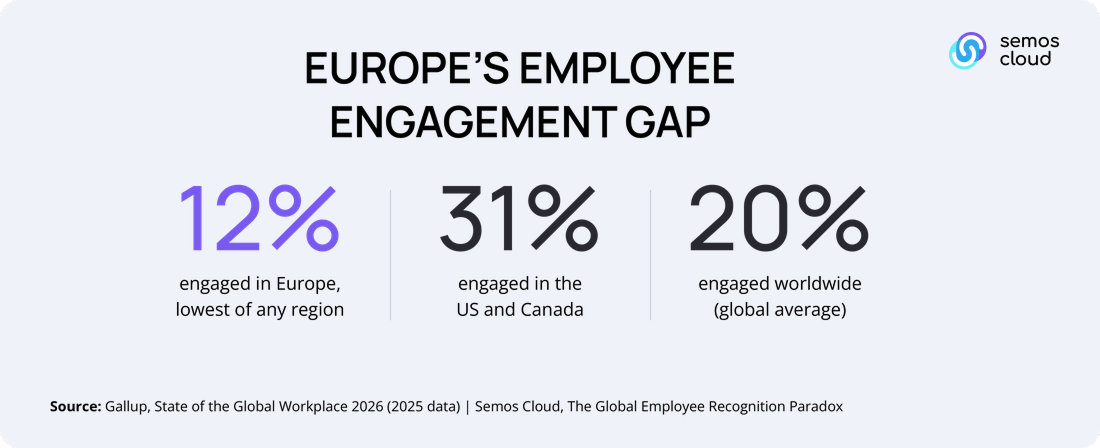
Yet just 12% of European employees are engaged at work, the lowest of any region. In the US and Canada, it is 31%. The global average is 20% (Gallup, State of the Global Workplace 2026).
In our data, programs with large European footprints run at moderate volume too.
This is not a culture problem. It is a design problem. And it usually comes down to three choices made before launch.
Three reasons the gap exists
1. Compliance is treated as an obstacle, not a design input. When GDPR and works councils show up late, programs launch late, narrow, and defensive. The social feed often gets switched off "to be safe." But visibility is what makes peer-to-peer recognition spread. Turn off the feed and you turn off the main reason people send.
2. One "Europe" strategy averages markets that do not behave alike. Western and Northern Europe run naturally peer-to-peer. Eastern Europe works differently. Poland is one of the most uncertainty-averse cultures measured (93), and Romania one of the most hierarchical (90). There, manager-initiated recognition and structured campaigns work best. An average of the two is too loose for Bucharest and too formal for London.
3. Translation is mistaken for localization. Translating the screens is not the same as localizing recognition. Phrasing that reads warm in Italian can read presumptuous in Dutch. Many Nordic workplaces push back on singling one person out. If the message feels wrong, people stop sending.
[cta]
How to run a recognition program in Europe
In Europe, the sequence matters more than the launch campaign. Here are five moves, strongest first.
1. Bring works councils in as co-designers, not approvers.
Involve employee representatives before launch, not after. Show them the data model, the feed settings, and what managers can see. Let them shape the rules.
Programs that do this launch with backing from employee representatives. That credibility is exactly what European adoption runs on. No launch campaign can buy it.
2. Run two behavioral models on one platform.
Do not split the difference. Set different defaults for different clusters:
- Western and Northern Europe: open peer-to-peer recognition with light structure
- Eastern Europe and other high uncertainty markets: manager-initiated awards, clear criteria, structured campaigns, and leaders who go first
Same platform. Same values. Different starting points.
3. Report by cultural cluster, not by region.
A single "Europe" line in a board report hides a 59-point cultural spread. A thriving peer program in the UK and a thriving manager-led program in Romania can average out to something that looks mediocre.
Split reporting into at least two clusters. Put unique sender rate over the last 90 days at the top for each. That is the percentage of employees who sent at least one recognition in that window.
4. Localize the language of recognition, not just the screens.
Give people message prompts written by local teams, not translated from English. Let employees choose between team and individual recognition. Test the tone with local HR before launch.
5. Settle award tax per country at the design stage.
Decide which awards are taxable, who covers the tax, and how it shows on a payslip. Do this before launch. An employee who gets a surprise tax bill stops trusting the program.
One thing not to do: do not switch off social features to avoid GDPR risk. Work with your data protection officer to configure them instead. Opt-in visibility and clear retention rules keep the feature and the trust.
[cta-2]
Europe as the bridge in your global program
Most recognition never leaves its home country. In US-centric programs, 96% to 99% stays local. Even multi-regional companies keep 70% or more in their home market. Only about 1% of deployments see 15% to 25% of recognition cross borders.
European hubs are often where that changes. European teams work across both hierarchical and flat norms every day. Many sit between APAC operations and Americas headquarters. That makes them natural translators, and natural connectors for recognition between regions.
In our 22-country deployment, split 40% APAC, 40% Europe, and 20% Americas, recognition crossed borders every day.
That flow does not happen on its own. It has to be engineered:
- Translated impact stories that show one country what another country's team delivered
- Country-pair campaigns that ask two specific locations to recognize each other
- Recognition built into global project retrospectives, where cross-border work is already visible
- Leadership storytelling that celebrates cross-border recognition in public
How Semos Cloud helps
Legitimacy is a design problem, and it is one we build for.
Our recognition and rewards platform is built for European security and compliance from the ground up, with GDPR-compliant data handling and configurable feed visibility. It supports peer-to-peer, manager-initiated, and team recognition on one platform, so each cultural cluster gets the right defaults. Tax handling works country by country. And it runs inside SAP SuccessFactors, Workday, and Oracle HCM, the systems many European enterprises already use.
Across our enterprise customers, that shows up as 24% lower voluntary turnover among employees actively engaged in recognition, 42% higher manager effectiveness scores, and 3.5x average ROI within 12 months.
Find more client success stories in our Customer Hub.
What Europe can teach your global program
Europe is where you learn to build recognition that survives scrutiny.
The legitimacy-first sequence you are pushed into here is the same one that makes programs last in every other high-regulation, high uncertainty market you enter. Bring representatives in early. Set data rules before features. Let leaders go first where people expect it.
The platform can stay the same. The sequence should start with trust.
Employee recognition metrics to track in Europe
- Unique sender rate over the last 90 days, by cultural cluster. Compare Western and Eastern clusters separately. Look for whether participation is broadening in each.
- Cross-border recognition. Track how much recognition flows through European teams to APAC and the Americas. This shows whether Europe is acting as a bridge.
- Recognition volume by culture group. Look at volume next to participation for each cluster, not for "Europe" as a whole.
- Manager participation. In Eastern clusters, manager-sent recognition should lead. In Western clusters, watch whether peer recognition grows beyond it.
Want the full study? It covers all four companies, the benchmark framework by peer group, and the four-level global recognition maturity model. Read The Global Employee Recognition Paradox.
Book a demo to see how Semos Cloud can help you build a recognition program that earns trust across every European market.


Explore related articles

%20(1).png)
Ready to unify your people programs?
Stop running recognition, rewards, communications, and development in silos. See how Semos Cloud brings it all together in one AI-powered platform, built for enterprise, certified for compliance, and proven at scale.