

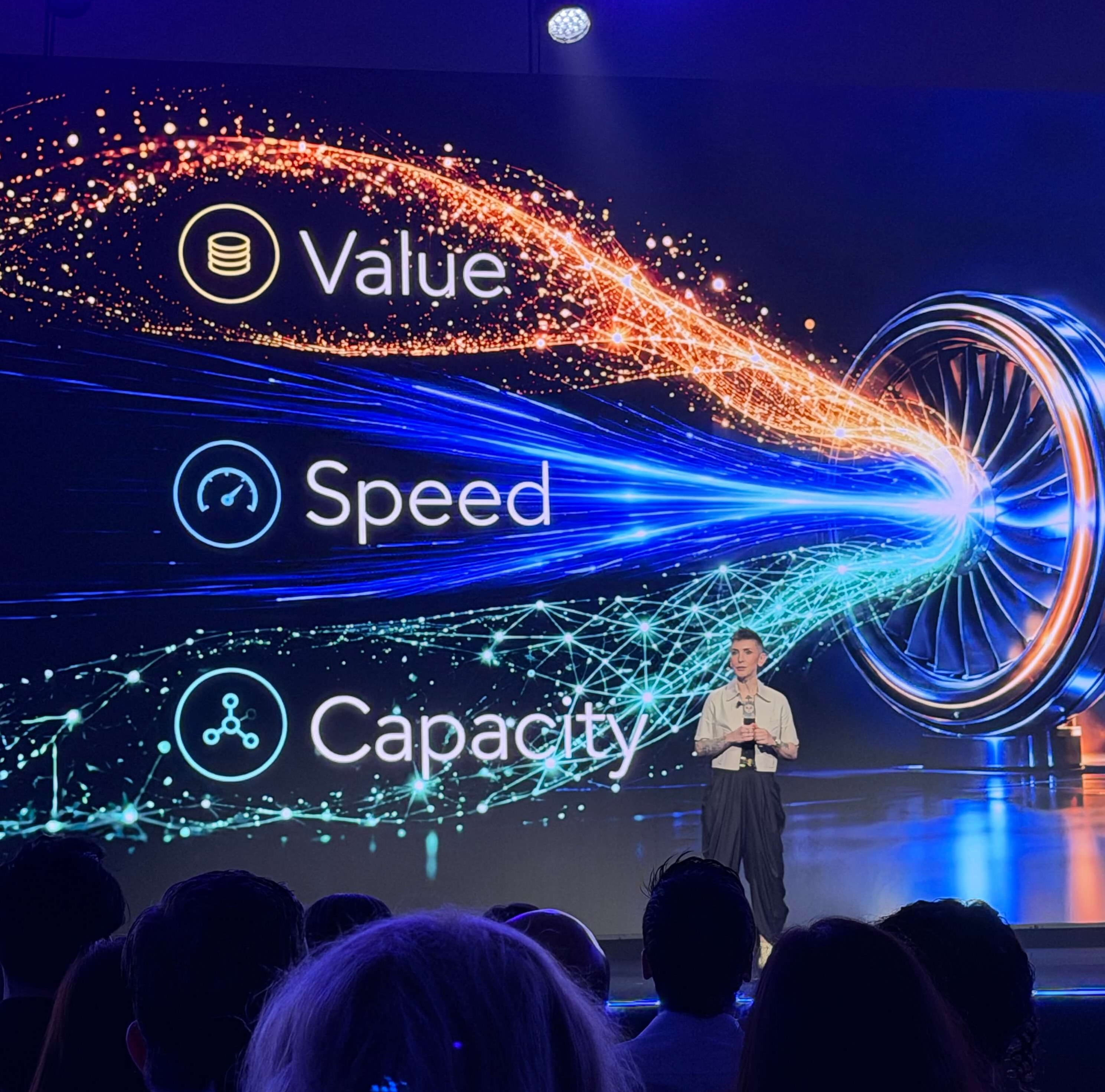
Three days. Twenty-plus sessions. Dozens of analyst conversations. The HR profession showed up to Orlando at the end of October 2026, and for the first time in three years, the AI conversation sounded different.
The automation argument is over. What Gartner's analysts, named practitioners, and HR leaders argued about this year was what to do with the capacity that AI creates. Across every room that mattered, the operating word was intelligence. Decision intelligence. Skills intelligence. Recognition intelligence. Manager intelligence.
What was the real takeaway from Gartner HR Symposium 2026? Across analyst sessions and practitioner cases, the recurring message was that productivity gains alone no longer add up. HR's next competitive layer is decision intelligence, the ability to turn workforce signals into skills decisions, recognition decisions, and manager decisions. Automation has become table stakes. Intelligence is the new frontier.
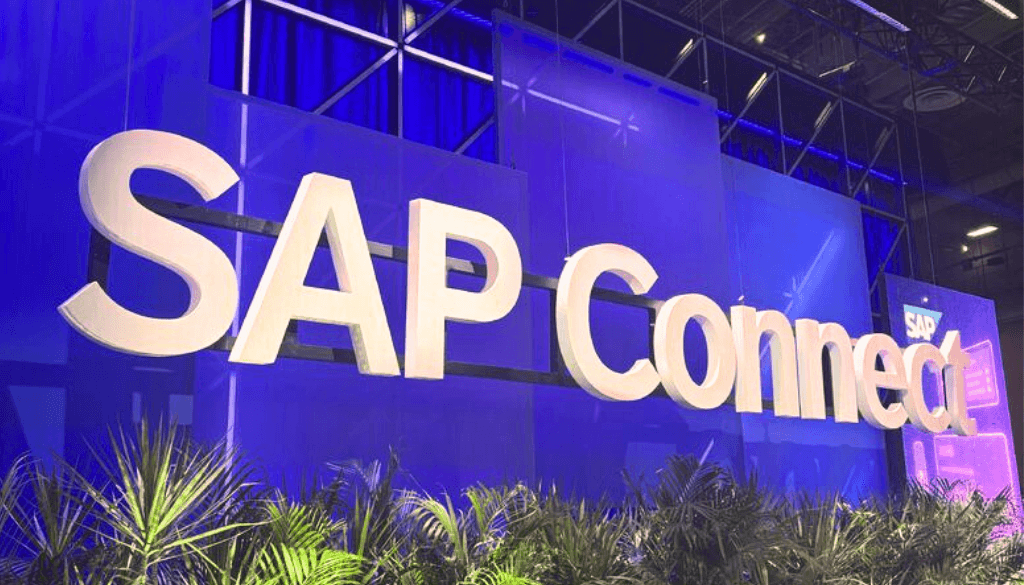
Semos Cloud attended Gartner HR Symposium 2026 at the Walt Disney World Dolphin in Orlando, sat in on analyst sessions with Eser Rizaoglu, Ranadeep Chandra, Kayla Velnosky, Joe Coyle, Jessie Knight, and Rachael Dix, and spoke with Deloitte's Kyle Forrest on the floor. This piece is a recap for HR leaders who could not attend, and a pulse check for the ones who did.
Here is what you'll find below:
- The three themes that cut through every session
- Where Gartner's analysts are pointing in 2027
- The practitioners: what deployed AI in HR actually looks like
- The Semos read: what Orlando means for the PCI layer
- Five moves to run Monday morning
The three themes that cut through every session
Here is the signal worth noticing. Across more than twenty sessions, three themes repeated without coordination between speakers. Analysts, consultants, and practitioners circled back to the same ground, over and over. That kind of accidental consensus is worth paying attention to.
"Productivity doesn't add up to too much", decision intelligence is the real frontier
The quote came from Eser Rizaoglu, VP Analyst at Gartner. In his session on AI use cases driving value for HR, he said:
"Productivity doesn't add up to too much. If you have small productivity here and there, it's not doing too much for you."
Rizaoglu's data: Gartner's 2026 survey of more than 800 C-suite leaders shows HR AI investment rising from around $580K per HR function in 2025 to around $650K in 2026. Roughly 10% of a typical HR functional budget. Yet the ROI story so far has been messy. The reason: the industry has been chasing automation targets that produce isolated time savings but no compounding advantage.
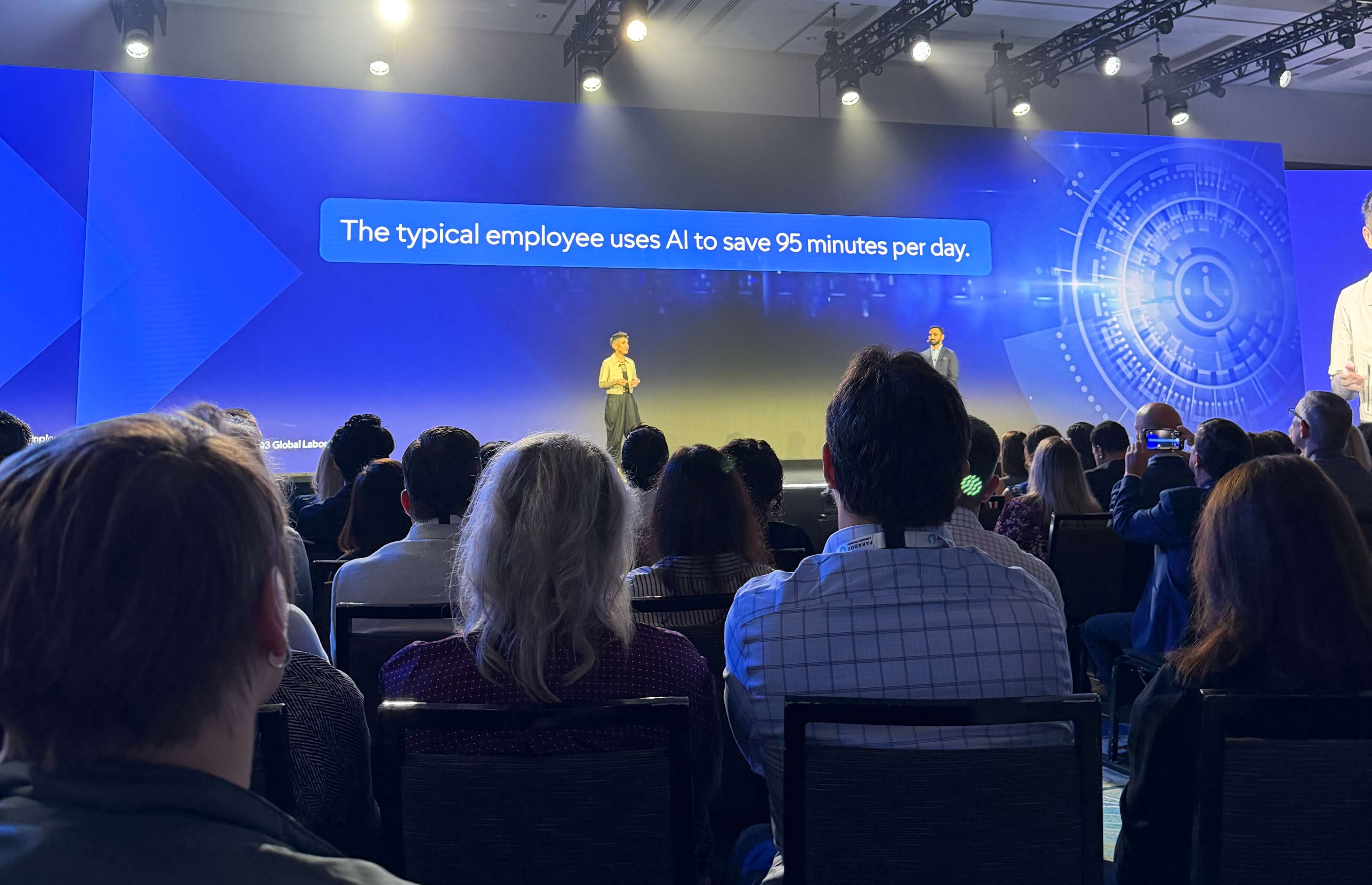
Rizaoglu's reframe: the most mature HR functions have moved past automation and are focused on decision intelligence. The question is no longer "which task can we automate?" It is "which decision can we make better with the data our systems already carry?"
A different muscle for HR to build. And the place the real competitive advantage lives.
Culture has to move at the speed of work
Jessie Knight (Gartner VP Analyst) opened her Monday session with a stat that reframes how HR should think about transformation: 52% of CHROs say their CEO has communicated a focus on high-performance culture. Only 35% believe they have the culture to drive that performance. A 17-point perception gap at the executive floor.
Rachael Dix (Gartner VP Analyst) added a sharper edge in a parallel track: 65% of leaders want faster change adoption, 52% name growth as a priority, 77% pursue cost efficiency. All three at once. Predictably, 72% of employees report lower productivity under heavy change, and 64% report lower engagement.
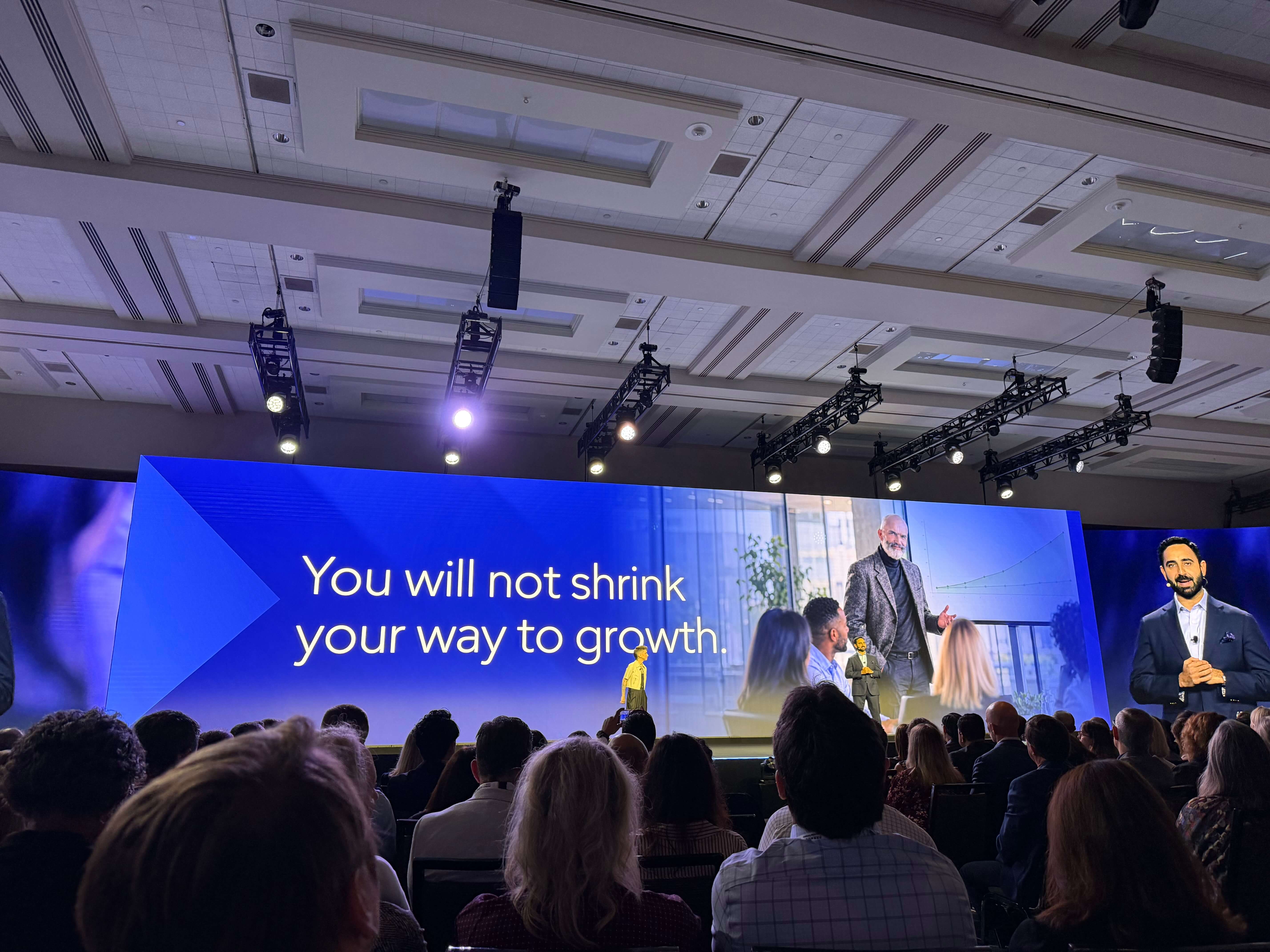
Knight's framing stays with you: senior leaders set the destination. Managers chart the path. The organizations where culture transforms at the speed of work show real gains, up to 1.7x higher productivity, 2.3x higher performance, 3.7x higher engagement, and 3.1x higher innovation. Two-thirds of organizations do not get there, and the reason is almost always the same: managers are not equipped to move culture at the pace strategy demands.
Recognition is the lever everyone underestimates
Kayla Velnosky (Gartner analyst and author of the 2026 Total Rewards Preferences Survey, which covered 10,000 employees worldwide) delivered the single most striking data point of the week.
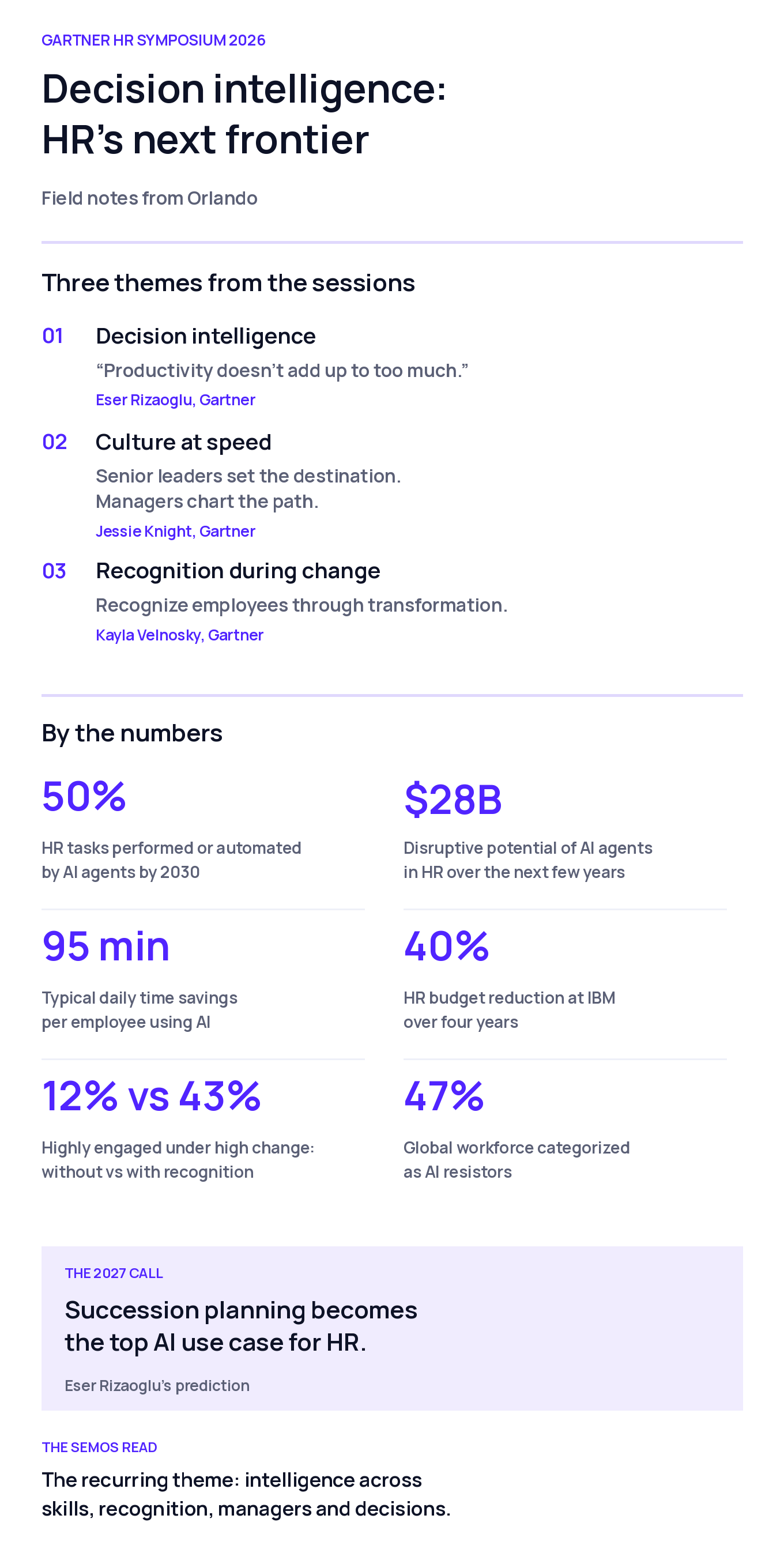
Her finding: employees who experienced high change in the past year and received no recognition show 12% high engagement. Employees who experienced the same level of change with recognition show 43% high engagement. Same change. Same stress. Nearly four times the engaged employees on the other side of it.
Rachael Dix's data lines up: high engagement reduces employee fatigue by up to 39% and lifts intent to stay by up to 30%. Velnosky added a second layer. The engagement curve jumps again when employees receive two or more forms of recognition during the change window. One form helps. Multiple, overlapping, consistent recognition is what breaks the curve.
Her four change-ready behaviors to recognize (worth writing down): teaching new change skills, pushing back productively, quitting at the right time, and growing through discomfort.
For organizations that have been running recognition during change programs for a decade, this reads less like news and more like confirmation of why the recognition layer has been quietly compounding advantage.
Where Gartner's analysts are pointing in 2027
When the people who write Gartner's forward research all nudge in the same direction, HR leaders should pay attention. Here is where the analysts were pointing in 2026 toward 2027.
Eser Rizaoglu: build skills intelligence before anything else
Rizaoglu's sequence of the top three AI use cases for HR value is specific and worth memorizing in order:
- Skills management
- Labor market intelligence
- Career pathing
The sequence matters. Each builds on the one before. You cannot do career pathing without labor market intelligence. You cannot do labor market intelligence without a working skills ontology for your workforce. HR teams who try to jump straight to the headline use case (career marketplaces, succession, learning recommendations) without the underlying skills graph end up with pilots that stall.
Named cases from his session: Dr. Reddy's Pharmaceuticals used Lightcast to build their skills management foundation. Simmons Health, cited as a particularly notable example, built 15,000 active succession plans on Phenom. A production system in daily use.
Rizaoglu's 2027 call: succession planning becomes the top AI use case for HR. His reasoning: the shelf life of skills is falling and the workforce is aging. Two curves moving in opposite directions, and the hinge between them is better succession.
Ranadeep Chandra: how to read the AI agents in HR market
Chandra opened his session with the stat every HR leader took home:
"By 2030, 50% of all HR tasks will be performed or automated by AI agents."
Then he turned the number into a market opportunity:
"The total disruptive potential just for AI agents in HR in the next couple of years is going to achieve something such as $28 billion."
Those are Gartner numbers. They explain why every vendor on the expo floor was pitching "agentic HR" this year.
Chandra's useful filter: Gartner published an Emerging Market Quadrant for AI Agents in HR with 15 vendors across four quadrants (market shapers, pace setters, pioneers, specialists). The quadrant itself is detail. The three categories underneath it are the part worth memorizing for HR leaders.
Three vendor categories HR leaders must disambiguate, per Chandra's framing:
- Inside-out. The HCM suite is adding agents to its own stack. The pitch: trust, continuity, and the system of record you already run.
- Enterprise AI. The general-purpose enterprise orchestration platform is adding HR as one of many workloads. The pitch: horizontal reach across functions.
- Middle-out HR specialists. Vendors that know HR workflows and are purpose-built to turn specific HR signals into specific HR actions.
Three categories, three sales motions. Buyers who open with "inside-out, enterprise AI, or specialist?" learn more in sixty seconds than they do from the full vendor pitch.
Joe Coyle: the $4 billion total rewards puzzle
Coyle (VP, Team Manager at Gartner) delivered the business case for rethinking total rewards. His 2026 Gartner global conjoint survey covered 10,000 employees across 18 countries and 72 total rewards plan design attributes.
The pressure numbers:
- Americas total rewards expense rose 30% as a percentage of operating expense over the last 5 years.
- Median per-FTE total rewards expense in the Americas sits around $118,000.
- Highly relevant total rewards drive 17% higher intent to stay and 17% higher performance.
Coyle's thesis line was blunt:
"The age of the war for perks is likely over."
Translation: perk inflation has stopped paying off. The real pull sits in relevance (which rewards actually matter to a given employee segment), cadence (how often rewards show up), and clarity (whether employees understand what they are being paid for). His three moves to run on Monday: accelerate the bonus cycle from annual to quarterly in at least one business unit, deprogram wellbeing (strip the ones no one uses), and disrupt the boardroom narrative that total rewards is a cost center rather than a performance system.
Chris Heater: AI data readiness is a culture question
Heater's session on AI data readiness landed on a counterintuitive insight. The blocker to enterprise AI sits upstream of the technology stack. It is the posture the organization takes toward its own data.
His data: 52% of C-suite leaders say AI investments are limited by poor data quality and availability. His counterexample: Takeda ran an internal campaign called "Happy Data, Happy Customer." Employees across the organization volunteered for data stewardship roles. People wanted to be custodians of better data because the campaign framed it as service to a customer, not a chore for compliance.
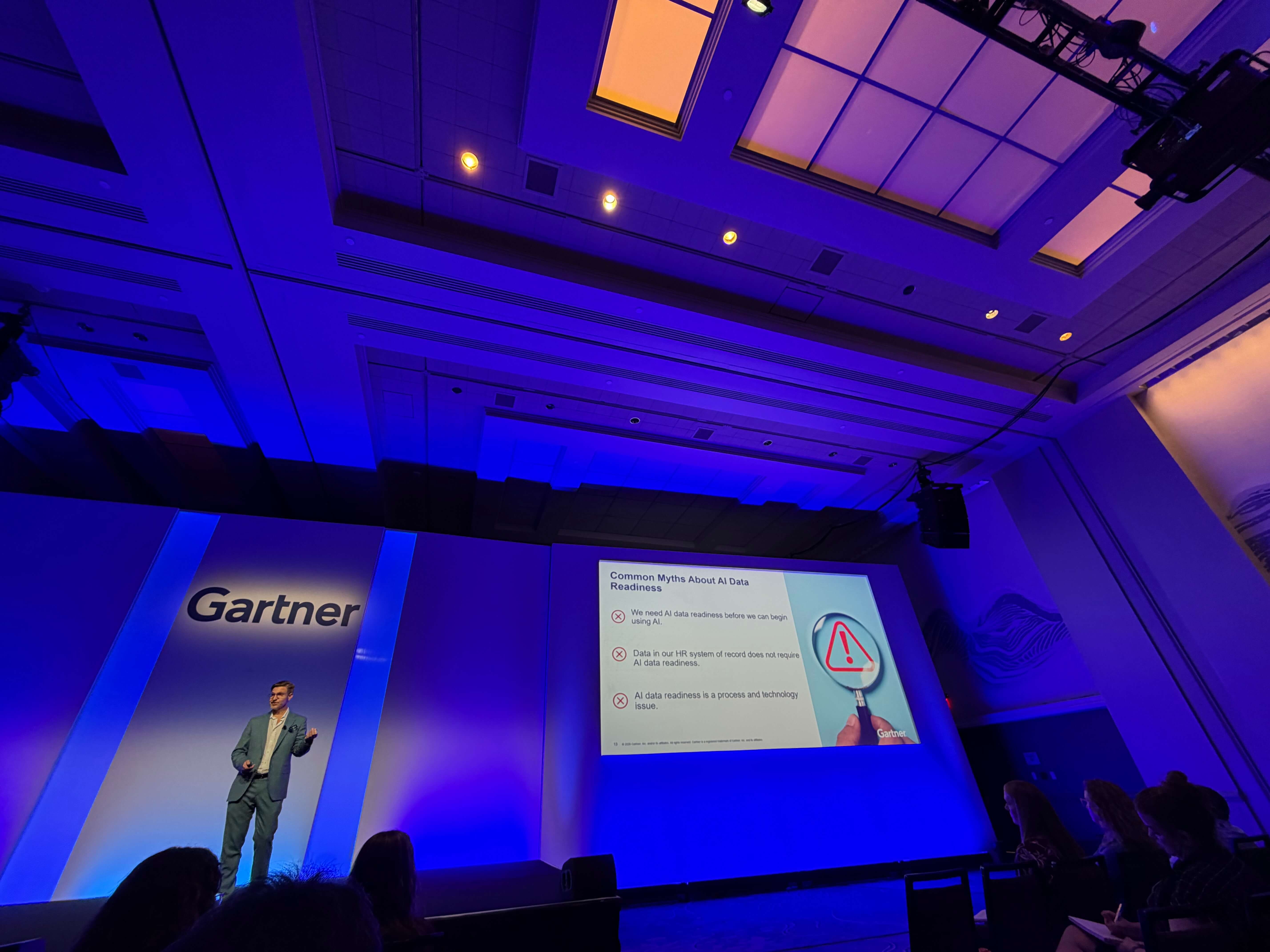
Takeaway for HR: AI data readiness programs that frame data as a cultural asset outperform the ones that frame data as a technical obligation.
The practitioners: what deployed AI in HR actually looks like
The analyst thesis holds up only if practitioners can execute. Orlando showed it can be done.
IBM: three operating modes for AI in HR
The IBM session delivered the operating-model framework that got the most pens-up moments of the week. IBM reported a 40% reduction in HR operating budget over four years, driven by rethinking the mix of three modes:
- Human-led. The human owns the decision end-to-end. Example: a termination conversation.
- AI-assisted. The human owns the decision and the AI prepares the ground. Example: a manager drafting a performance review with an AI first-draft to react against.
- AI-executed. The AI owns the decision with the human reviewing exceptions. Example: routine policy answers, status checks, standard approvals.
The sharpest line from the IBM speaker:
"One process might touch all three."
And the warning:
"Automation is just going to scale your bad process, and AI is going to scale it a lot faster."
Translation: build the operating model before you deploy the agent.
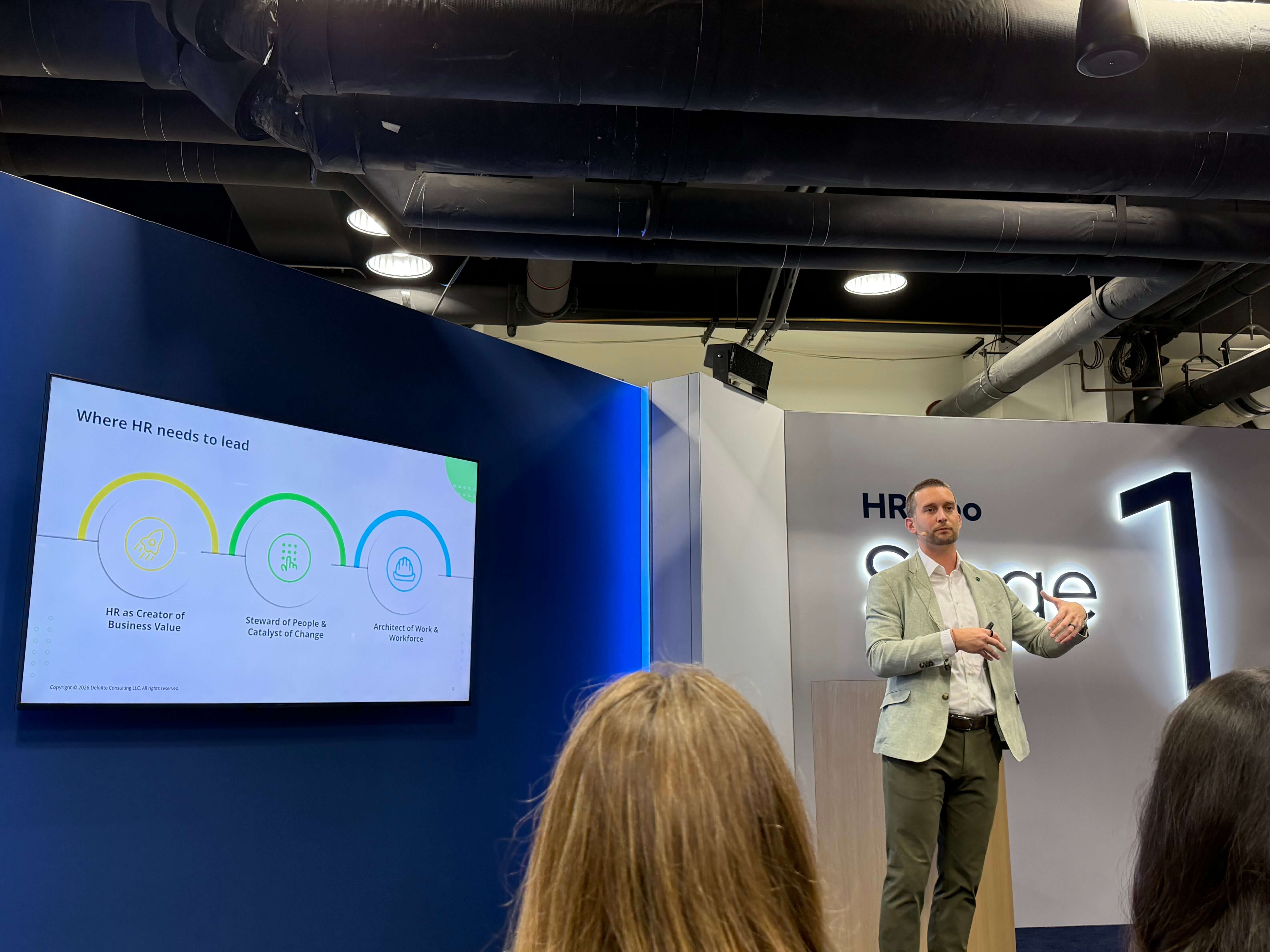
Deloitte 2026 Human Capital Trends: fast and nimble for the sake of what?
Kyle Forrest (Future of HR Leader, Deloitte) walked attendees through the 2026 Human Capital Trends findings, drawn from 9,000+ respondents across 70 countries. The headline: 70% of business leaders say their strategy is "fast and nimble."
Forrest's question, delivered dry:
"Fast and nimble for the sake of what?"
The frame he introduced: cultural debt. The HR equivalent of technical debt. Every org that has been racing to be fast and nimble for the last four years has accumulated unexplored decisions, unresolved tensions, and an eroded sense of why anyone is working hard in the first place. The debt compounds until someone pays it, usually in attrition.
Forrest cited Jensen Huang's challenge to CEOs this spring (via Deloitte):
"If you can't think of anything to do with capacity other than reduce headcount, you are unimaginative."
The Deloitte framework for the capacity question: roles become AI-assisted, AI-powered, or AI-executed, and HR has to be deliberate about which category each role should land in, instead of letting line managers improvise it one hiring decision at a time.
Three CHROs, three starting points, one answer
The AI Strategy and People Management panel, moderated by Lydia (Gartner analyst), featured three practitioners at different stages: Carlota Uga Salas (Softys), Tom Goggin (Penn Mutual), Dominic Boyd (Lee County).
Penn Mutual's Goggin reported the most structured deployment approach of the three. Tiger Teams, 15 agents built in 5 sprints over roughly 6 weeks. The post-deployment AI engagement survey came back with 8/10 and 9/10 ratings on empowerment and skills development.
Dominic Boyd (CHRO Lee County) delivered the quote that got the room nodding:
"HR does not need to learn how to write code."
The point: the current generation of agentic tooling is written for HR practitioners, not for software engineers. HR leaders who assume they need to retrain their teams as developers are solving yesterday's problem.
The sobering counter from the panel: Gartner's annual Labor Market Survey finds that 47% of the global workforce categorizes as "AI resistors." Low utilization, low sentiment. Nearly half the people HR is trying to serve are not yet on board.
The Semos read: what Orlando means for the PCI layer
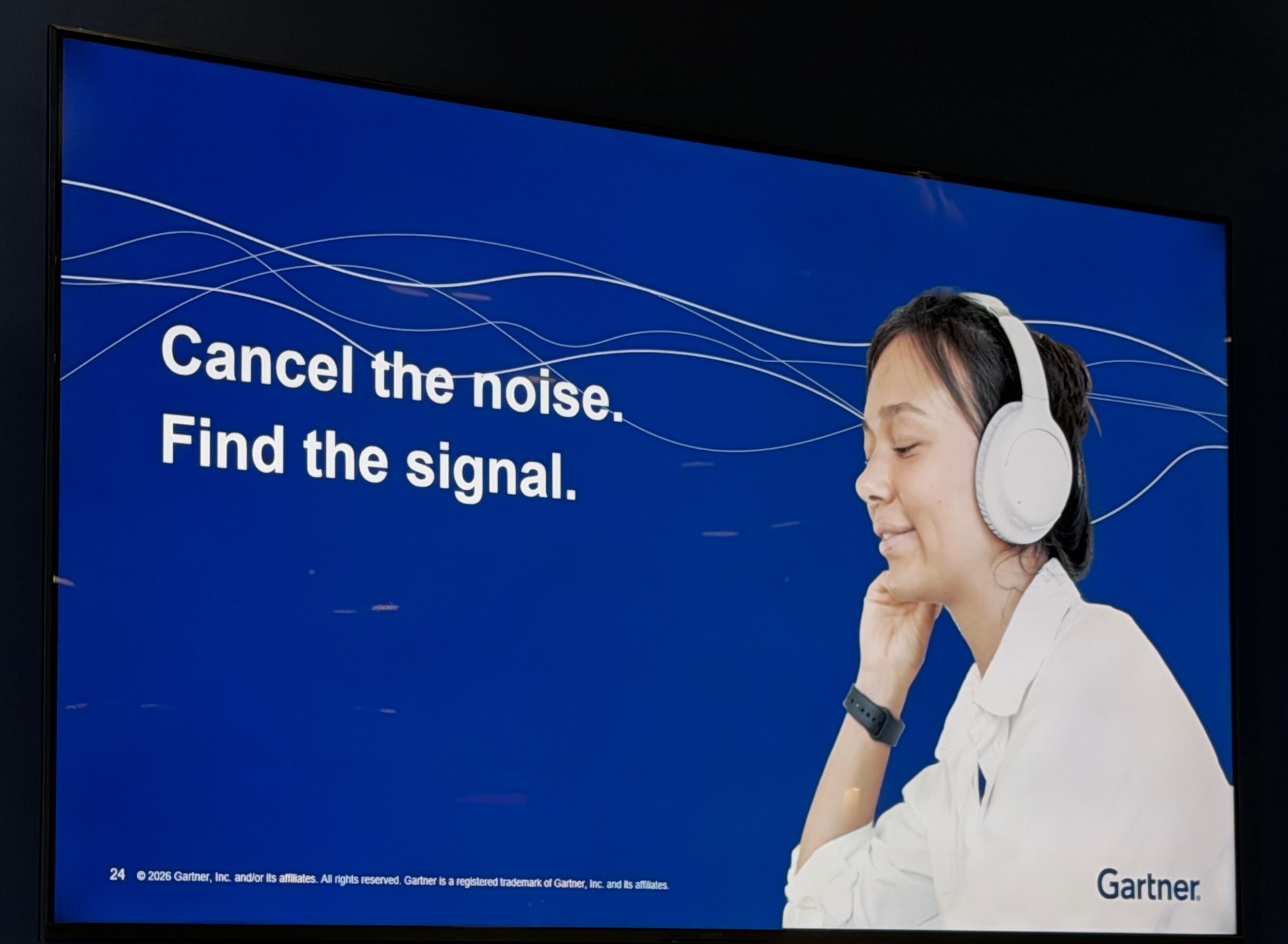
I spent three days in Orlando listening carefully, and I came home with one conviction: the operating word of 2026 was intelligence.
Rizaoglu called it decision intelligence. Velnosky called it recognition intelligence. Coyle framed relevance as intelligence. Knight pointed at managers as the people who turn executive strategy into readable paths. Chandra sorted the vendor market into three categories so HR buyers could see them clearly. Five analysts, five data sets, same conclusion.
That is the layer Semos has been calling People and Culture Intelligence, and the read from Orlando is that Gartner is now pointing at the same place from a different trail.
A few things I want HR leaders to take away.
Recognition during change is the stat you cannot explain away. 12% engagement without, 43% with. Same change, same stress, nearly four times the engaged employees on the other side. If you lead HR for an organization in transformation, and almost all of them are, Velnosky's data makes the business case for your next review cycle.
Managers do not need another dashboard. They need a decision. Knight is right that managers chart the path. Dix is right that engagement during change collapses without them. What managers get today is more data. What they need is one next step, in context, from a system that reads their team. That is where manager-coaching capability earns its place.
Vendor noise is going to get worse before it gets better. Chandra's three-category filter is the fastest buyer tool I have seen all year. Inside-out, enterprise AI, specialist. Make the vendor pick. The answer tells you most of what you need to know about whether they understand the problem they are trying to solve for you. Worth adding: the three categories are not mutually exclusive. The inside-out agents own the system of record. The specialist layer reads signals the record does not carry (behavioral recognition data, engagement during change, manager-moment context) and feeds decisions back through the HCM, not around it. That is the integration posture to look for.
One thing bugged me all week. The stat that haunted the hallway was Gartner's own 47% of the global workforce as "AI resistors," and I could not find a single session that spent real time on what to do about them. The programming was pitched at the Fortune 500 HR team with budget, bandwidth, and executive buy-in. The bottom half of the maturity curve, the frontline workers, the resistors, the people HR is supposed to serve, was almost absent from the catalog. If nearly half your workforce is skeptical of the thing you are investing in, that is the session HR Orlando needed, and the session that most of us came home still writing in our heads.
And one thing I think Orlando under-covered. Almost every session talked about AI agents reaching into dozens of systems to surface answers. Very few talked about what happens when the recognition signal from the engagement layer becomes the training data for the manager-coaching agent, running through the governed HCM data layer rather than alongside it. That loop (recognition data informing coaching, coaching producing better recognition moments, both feeding skills intelligence) is where the next advantage sits. That loop is PCI, and that is why we built it.
Semos was in Orlando listening, and the frame we have been building for ten years is the one Gartner is now narrating from the stage. That is what it felt like to sit in those rooms this week.
What HR leaders should do Monday morning
Five concrete moves worth running this week.
- Pull your recognition-during-change exposure. Count how many of your most recent transformation initiatives came with a documented recognition plan. If the answer is zero, you have the Velnosky gap. Fix it before your next change announcement.
- Sequence your AI use cases in order. Rizaoglu's order holds: skills management first, labor market intelligence second, career pathing third. Succession planning next year. Skipping stages produces pilots that stall.
- Make every AI agent vendor pick a category: inside-out, enterprise AI, or specialist. If they refuse to pick, they do not know what they are selling you. If they pick two, ask which signal set each one carries.
- Pilot a quarterly bonus cycle in one business unit. Coyle's data shows employees value cadence almost as much as amount. Run the pilot, measure retention and performance against a matched unit, and bring the results to your next total rewards review.
- Name your enterprise orchestrator before you need one. If no one in your organization owns the single-front-door decision for employees, your workforce is about to meet twelve different "ask-HR, ask-IT, ask-Finance" bots. Pick who owns the orchestration layer before the sprawl shows up.
Want twice-monthly reads on how this plays out? Subscribe to the HR Navigator. If the People and Culture Intelligence framing lines up with what you heard at Orlando too, talk to the Semos team.


Explore related articles
Ready to unify your people programs?
Stop running recognition, rewards, communications, and development in silos. See how Semos Cloud brings it all together in one AI-powered platform, built for enterprise, certified for compliance, and proven at scale.