


- Around 200 SAP agents are generally available today, but SAP itself says the scoreboard is business outcomes, not agent counts.
- No expert we spoke with dismissed a claim as pure myth. The debate is about speed, scope and accountability, not direction.
- Governance was the one unanimous reality. 42% of SAP Connect's virtual audience named trust and governance the biggest barrier to AI agents.
- Context beats the model. Connected people data is the clearest marker of HR tech maturity, and most organizations still keep recognition, listening and feedback apart from the HCM.
- Autonomy is earned process by process. Decisions about pay, careers and standing at work stay with a person.
- Managers are where AI turns into employee impact, when they get timely context instead of another dashboard.
Around 200 SAP agents are live. What matters more than that number?
At SAP Connect 2026, the autonomous enterprise stopped being a preview. More than 20 assistants and around 200 agents are generally available, Joule Work is rolling out to every customer, and SAP SuccessFactors handed HR a clear mandate: automate, redesign, reinvent.
Then SAP CEO Christian Klein said the line that framed everything that followed.
"But the real story isn't the number of agents. It's the business outcome they deliver for you, our customers."
- Christian Klein, CEO, SAP
That is the question HR leaders are now being asked to answer. So we took the biggest claims from the stage to eight independent HR tech experts from Mercer, The Josh Bersin Company, Brandon Hall Group, diginomica, Technology Evaluation Centers and others, and asked them one thing: myth or reality? The result is our new report, What autonomous HR really means for your team. Here is the through line.
[cta]
Business change has become workforce change
SAP SuccessFactors did not open its HCM keynote with technology. It opened with the workforce. A CHRO described how AI changed the way her customers discover products, which changed the role of her stores, which meant new skills across the entire workforce.
SAP's point was that this is no longer the exception. The numbers from its Future of Work Research Lab show how wide the gap is:
- HR spends nearly two thirds of its capacity on operational work.
- 72% of executives say companies claiming to transform work with AI are mostly automating existing jobs faster.
- 65% say the capacity AI frees up is not being strategically redeployed.
- 88% say redesigning work creates significant enterprise value, and they rank HR as the number one owner of that work.
The broader point: HR has been handed the redesign of work. Whether it is ready depends on whether its leaders step in first.
Automate, redesign, reinvent works better as a flywheel
SAP set out three connected steps for autonomous HCM, each shown live with Joule. Automate frees HR from operational work, like tracing a payroll error to a missing state tax code in seconds. Redesign rethinks tasks, roles and teams. Reinvent rebuilds how people are hired, developed, moved, measured and rewarded.
The experts agreed with the direction, and added a challenge. Tara Cooper of Mercer sees automation as the obvious part, and the muscle of redesign as the harder one to build. She also questioned the order:
"I think those are the right steps, but I do question if that is more of a flywheel, do we need to actually start some of that redesign and some of that rethinking of the work and not waste so much time automating things that are eventually going to go away."
- Tara Cooper, HR Tech Analyst, Mercer
Automation without redesign creates capacity nobody uses. Redesign without reinvention changes job descriptions without changing how people grow and are rewarded.
Outcomes are the new scoreboard
Every expert agreed AI agents will change how HR operates. None of them treats the change as automatic. Kathi Enderes of The Josh Bersin Company gave a verdict that captures the whole report: absolutely yes, but it won't be automatic.
The organizations getting it right, she said, start with the value they want to create and work back to the technology. Tami Nutt, independent HR tech analyst and advisor, set the condition more sharply: if companies use AI only to increase speed and cut headcount, the promise will not be realized.
The wider market agrees. McKinsey finds no more than 10% of organizations are scaling AI agents in any single function, and Gartner expects over 40% of agentic AI projects to be canceled by the end of 2027.
What to ask instead: not how many agents are switched on, but which outcome each one moves, who owns it, and how anyone will know it worked.
Context beats the model
"A powerful model is not enough. Business outcomes require something more fundamental. They require context."
- Siva Sundarasan, SAP SuccessFactors
SAP backed this with a knowledge graph mapping more than 7 million data fields and its intent to acquire TechWolf. The experts largely agreed that connected people data is the clearest marker of HR tech maturity. Steve Goldberg of SBG Consulting put it in one line: data, context and related signals are now worth more than foundational automation of the process.
David Forry of Brandon Hall Group added a caution. 46% of organizations remain in the first two phases of AI maturity, despite the technology available. Technology creates the opportunity, but the operating model decides how much value it delivers.
For HR, this matters most where guessing is riskiest. An agent that flags attrition or suggests a promotion is only as good as the context behind it, and in most organizations recognition, surveys, feedback and communications still sit apart from the HCM. What disconnected tools cost you is usually more than the vendor invoices.
Autonomy is earned. Governance is the one unanimous reality.
Autonomy was the most confident claim on SAP's stage and the most contested one in our conversations. Predrag PJ Jakovljevic of Technology Evaluation Centers sees human-in-the-loop automation as already real for structured, high-volume work. Jon Reed of diginomica called it both a myth and a reality: some processes will run on their own, but the fantasy that HR will need far fewer people is the myth.
On governance, there was no debate. Every expert who took the topic called it a reality. SAP's Chief Security Officer gave the main stage the numbers: 83% of enterprises use AI daily, but only 13% have true visibility of what it is doing. She also gave HR the three questions every people agent will face:
"Who owns this AI decision? Who can see what it is doing right now? And who can stop it?"
- Marielle Ehrmann, Chief Security Officer, SAP
Tami Nutt, trained in labor and employment law, called governance HR's biggest challenge already, and compared it to seat belts: good guardrails are what let a business go faster, not slower.
[cta-2]
Managers are where AI becomes employee impact
In the HCM keynote's rapid-fire round, promotions and accountability were named the things AI should never decide. Steve Goldberg, who has argued for line manager enablement for decades, called the manager's role a strong reality, with a nuance worth keeping. When people leave a manager, that manager may simply be overwhelmed, and that is context too.
"This is exactly where context is important. Because if an employee hypothetically says, I'm leaving because I don't have a good relationship with my manager, I'm not getting what I want out of my manager, it could be because the manager themselves is totally overwhelmed. And that's a big part of the context."
- Steve Goldberg, SBG Consulting HR Tech Advisory
On whether HR is ready to lead, Tara Cooper's answer was that it depends. Most HR leaders see the impact coming. Fewer know where to step in first and take accountability.
The value of AI in HR shows up when managers get timely context about their team, not another dashboard. One signal a manager can act on this week, such as who hasn't been recognized in 90 days, beats a quarterly report.
SAP builds the foundation. Semos Cloud adds the signal layer.
SAP SuccessFactors stays the system of record, and SAP's Business AI Platform, Joule and agents run the processes on top of it. What that foundation does not capture on its own are the people and culture signals around recognition, communications, listening, feedback, rewards and manager behavior.
That is where Semos IQ comes in. It follows the same human-in-the-loop approach SAP described on stage:
- A signal appears. Recognition drops, sentiment dips, or a strong performer has not been recognized in months.
- Semos IQ surfaces it to the right manager or HR business partner, in the flow of work or in Joule.
- An agent helps by drafting a recommendation, a message or a recognition.
- A person decides. Nothing happens without them.
- The outcome feeds back and sharpens the next signal.
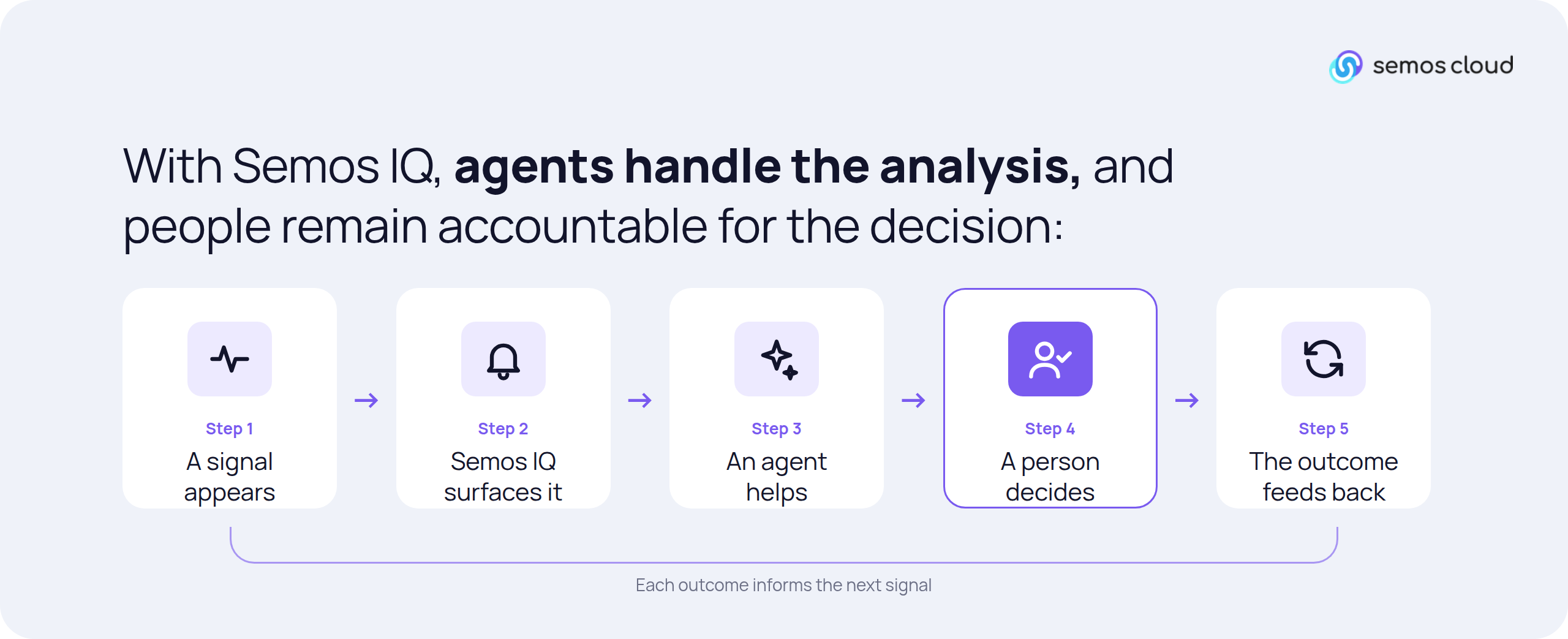
Because Semos Cloud is built natively on SAP BTP, all of this runs inside the same governance model as the SAP landscape it serves. At SAP Connect, Deloitte showed what that looks like at scale: recognition for more than 200,000 professionals, governed in SAP Business Data Cloud.
Five moves to make next quarter
The report closes with a practical roadmap. Closing the maturity gap does not start with more agents. It starts here:
- Inventory your agents and give each one an owner, including the ones employees built themselves.
- Map HR processes by risk before automating them: structured, regulated and relational.
- Name three decisions that need connected data, and let them set your integration roadmap.
- Redesign alongside automation, not after it. Decide where freed capacity goes before it arrives.
- Give managers context, not more dashboards.
Read the full report
This recap covers the through line. The full report goes deeper, with every expert verdict in their own words and the video conversations recorded at SAP Connect. Get the full report →
In the full report you'll find:
- Each expert's myth or reality verdict on SAP's biggest autonomous HR claims
- Video conversations with Tara Cooper, Kathi Enderes, Tami Nutt, Steve Hunt and Steve Goldberg
- SAP's autonomous enterprise architecture, explained for HR leaders
- How Semos IQ works alongside SAP, end to end
- A "what to do next quarter" action for every theme
About the contributors
- Steve Hunt, i3 Talent; partner, ASTA Advisors; formerly Chief Expert, Technology and Work, SAP
- Steve Goldberg, SBG Consulting HR Tech Advisory
- Tara Cooper, HR Tech Analyst, Mercer
- Kathi Enderes, SVP Research, The Josh Bersin Company
- Tami Nutt, Independent HR tech analyst and advisor
- Predrag PJ Jakovljevic, Principal Analyst, Technology Evaluation Centers
- Jon Reed, Co-founder, diginomica
- David Forry, SVP and Principal Analyst, Brandon Hall Group
Ready to see it in your own environment? Autonomy is a journey, but accountability is not delegated. If your people signals still sit outside your SAP landscape, the fastest way to see what they could tell you is to look at them inside it. Schedule a call with our team →


Explore related articles


Ready to unify your people programs?
Stop running recognition, rewards, communications, and development in silos. See how Semos Cloud brings it all together in one AI-powered platform, built for enterprise, certified for compliance, and proven at scale.