


SAP TechEd turned 30 this year with an ambitious agenda for what comes next. In Berlin, SAP outlined how Joule, agent development tools and business data will support its vision of the autonomous enterprise. Its announcements addressed the foundations needed to make that vision workable, including richer context for agents and stronger governance as they take on more responsibility.
Our team arrived with experience to contribute to that discussion. Over the past 18 months, we have been developing people and culture agents, bringing them into customer environments and reworking the architecture behind them. TechEd gave us an opportunity to share that journey openly, celebrate recognition for our work and connect with the SAP teams helping us advance it.
A partner agent race win grounded in customer adoption
One of the highlights for our team in Berlin was seeing our agent development work recognized alongside major systems integrators.
Semos Cloud qualified as a winner of the Partner agent race to SAP TechEd 2026, an initiative recognizing customer-adopted agents that have successfully completed SAP’s validation.
We presented 17 use cases drawn from our broader portfolio of more than 20 production agents. Our agents, listed in the partner AI catalog on SAP Discovery Center, build on our experience in recognition, rewards, communications and employee listening, supported by Semos IQ, the intelligence and engagement layer of our platform, and connected with SAP SuccessFactors context.
The recognition acknowledged the development and implementation work required to bring domain-specific agents into real customer environments, where they must fit established processes and support the people using them.
What it takes to build beyond the first agents
Filip Misovski, CEO of Semos Cloud, joined Steffen Pietsch, Head of Platform Product Management, SAP SE, for a full-room session, “Build your agent strategy: From use case to enterprise-ready AI platform,” to explain how we reached this point and where the work continues.
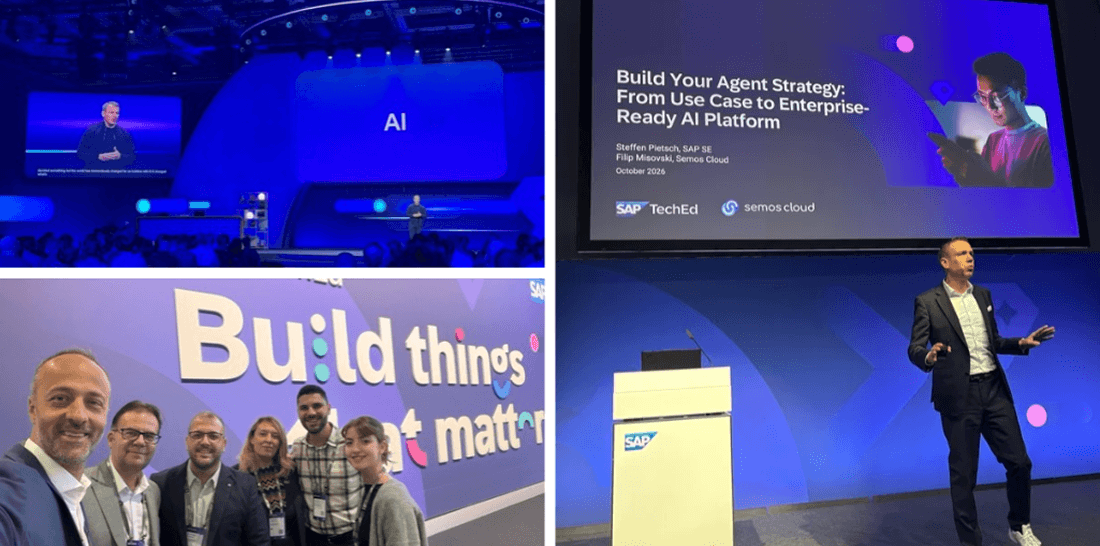
Drawing on his experience at SAP and in the partner ecosystem, Filip traced the evolution from established SaaS applications to an agent-enabled platform. Early AI capabilities helped users within existing workflows, such as drafting a recognition message or summarizing a report. Agents introduced a different development challenge: interpreting intent, accessing the right context and coordinating actions across systems.
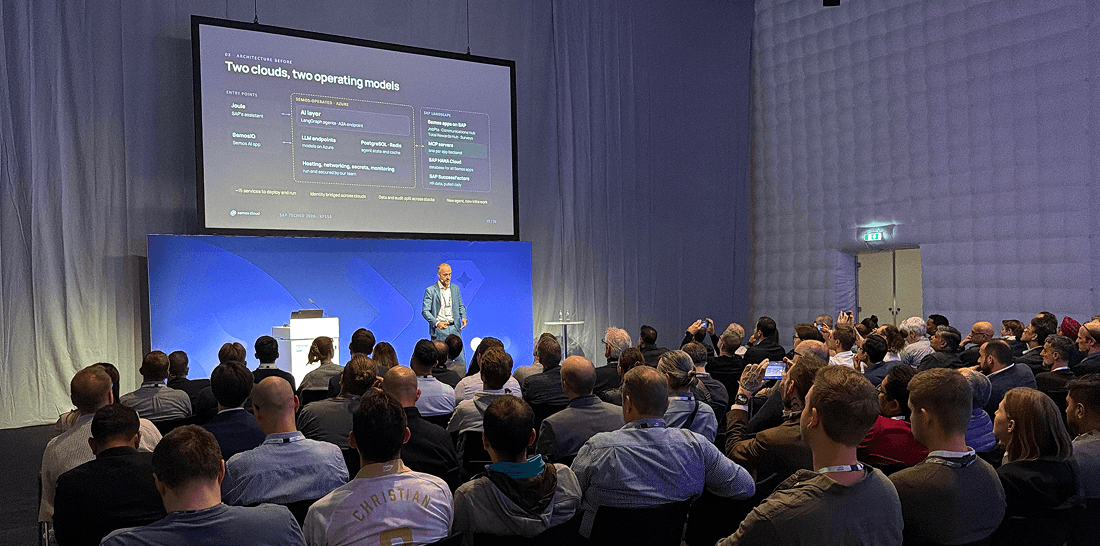
Our core solutions ran on SAP BTP, while our early agentic stack operated on Microsoft Azure. As the portfolio grew, maintaining both environments meant managing separate infrastructure, connecting identities across clouds and handling fragmented audit requirements.
The session covered the assessment, proof of concept and re-platforming work undertaken with SAP’s product management team. Consolidating onto SAP Business AI Platform reduced the services we operated from 15 to nine.
For our development team, the practical change is clear: adding a new agent now involves a Joule skill and a deployment, rather than the broader infrastructure work previously required. That gives the move from 15 services to nine a practical consequence: we can extend the agent portfolio on a shared foundation, with one SAP identity across the architecture and data access through MCP.
For Semos Cloud, this was a long-term platform commitment. As Filip explained, we are building on SAP Business AI Platform with the expectation that it will support our next generation of innovation, just as BTP supported the previous one.
Bringing our agents into the employee experience
The session showed two ways people can interact with our AI capabilities. In Joule, our agents helped a manager investigate gaps in recognition and follow through by recognizing an employee. Through conversation, the manager could identify who might be overlooked and submit a recognition message.
A second demonstration focused on Semos IQ, the intelligence and engagement layer of our platform. It helps employees, managers and HR teams spot changes in their people programs and understand what needs attention. They can ask an agent for more context, then choose whether to complete the task through chat or directly in the application.
Both examples connected insight with a practical next step, helping people address issues that might otherwise remain buried in a report.
Keeping the experience grounded in how people work
Customers will not abandon familiar screens simply because agents are available. Our approach combines conversations with established interfaces, allowing people to investigate through an agent, review details on screen and choose the interaction that fits their task.
"The goal is to give people the best way to get their work done. Sometimes that means a conversation with an agent; sometimes it means a familiar screen. Our platform needs to support both."
- Filip Misovski, CEO, Semos Cloud
The discussion also distinguished our current agent-enabled platform from the greater autonomy still ahead. The next step, as Filip described it, is to move beyond agents that respond when someone asks for help toward agents that can operate continuously, determine when attention is needed and initiate appropriate actions. That remains a development direction, with further work required on the controls and governance supporting it.
Taking the next step after TechEd
TechEd brought our progress and the work ahead into the same conversation. The partner agent race recognized agents already adopted by customers. Our joint session with SAP opened up the decisions behind that progress, including the infrastructure we changed and the experience we want to give people using our platform.
For organizations considering their own next step, Filip’s advice was to choose one use case and start. In people programs, that could mean helping managers identify overlooked contributions, making recognition easier for employees or giving HR more context for deciding where support is needed. Each provides a concrete starting point for exploring what agents can contribute and what they need to work reliably.
That is the perspective we take forward from Berlin: build around a useful task, connect it to the right context and give people a clear way to act. As we develop toward greater autonomy, those everyday needs will continue to guide our work.
[cta]


Ready to unify your people programs?
Stop running recognition, rewards, communications, and development in silos. See how Semos Cloud brings it all together in one AI-powered platform, built for enterprise, certified for compliance, and proven at scale.