


- Service anniversaries are the most predictable recognition cost, so forecast them from your HR data.
- Pick one investment level and apply it consistently.
- Design the milestone ladder so each step feels like progress, starting from the first year.
- Set award values per country, but keep the same milestones everywhere.
- Pair every award with personal messages; the experience matters as much as the amount.
Introduction
Most employee recognition budgets come with some uncertainty. You can't know exactly how often peers will recognize each other, or how many nominations a quarter will bring.
Service anniversaries are different. You already know who joined when, which means you can see next year's milestones today. That makes them the most predictable part of your recognition budget, and one of the easiest to get right.
They also matter more than their predictability suggests. A well-handled anniversary tells someone their years with the company were noticed. A forgotten or generic one tells them the opposite.
Here's how to plan a service anniversary budget that feels personal and stays easy to manage.
1. Forecast from your HR data first
Start with what you already have. Pull hire dates from your HRIS and count how many employees will reach each milestone next year. Do this by country if you operate in more than one.
This gives you a bottom-up budget that's grounded in real headcount, not an estimate. It also shows you where the big years fall, for example, a cohort that joined together during a growth period and will all reach a major milestone at once. This matters most in industries facing a wave of retirements, such as energy and utilities.
2. Choose your investment level
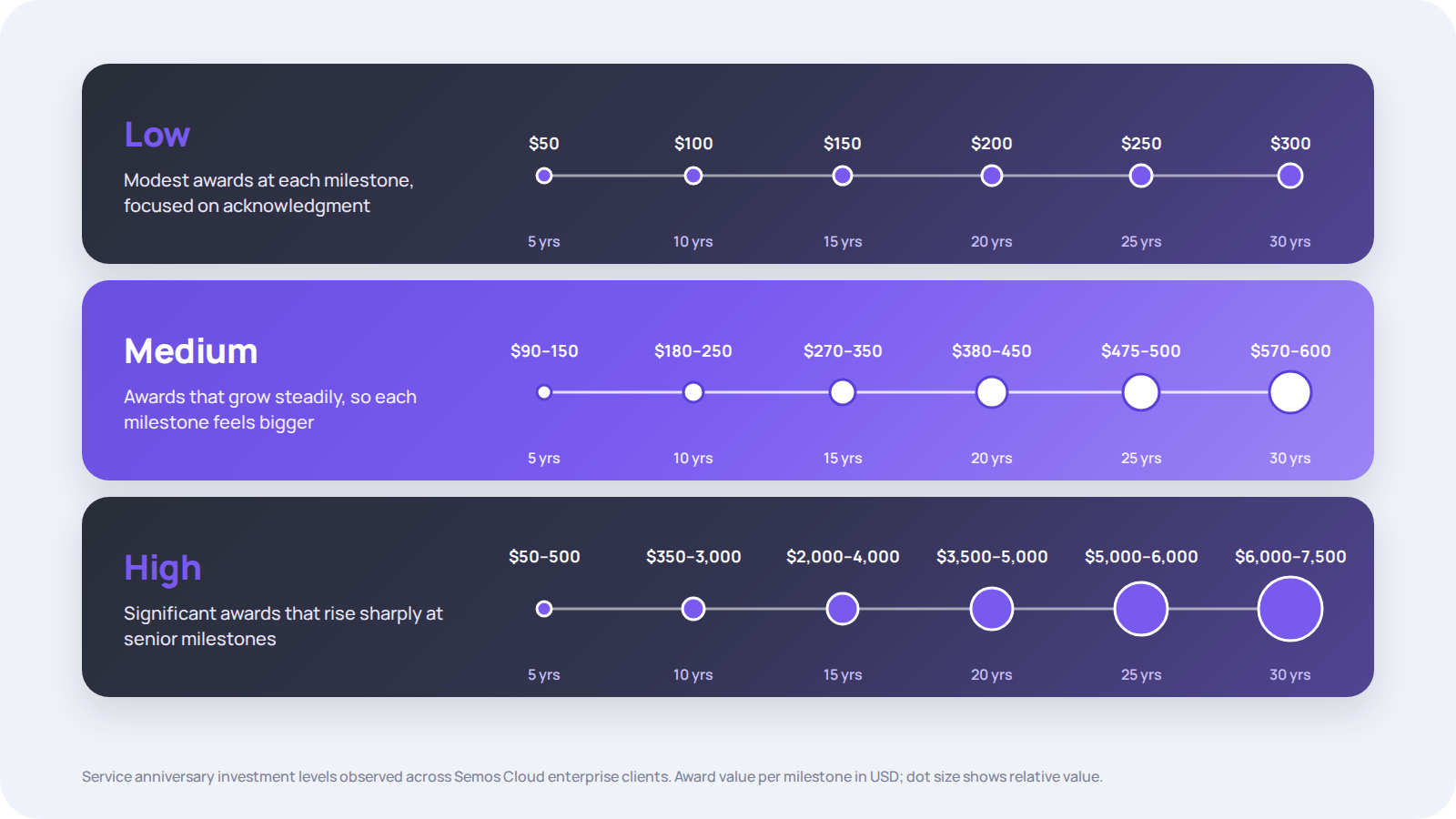
Organizations tend to fall into one of three investment levels for service awards:
- Low: modest awards at each milestone, focused on acknowledgment.
- Medium: awards that grow steadily with tenure, so each milestone feels meaningfully bigger than the last.
- High: significant awards at senior milestones, often used where long tenure is a strategic priority.
There's no right level for everyone. The choice depends on your industry, your retention goals and how much weight long service carries in your culture. What matters is choosing one deliberately and applying it consistently.
3. Design the ladder, not just the amounts
A milestone ladder is the set of tenure points you celebrate and how each one compares to the last. A few principles help:
- Make each step feel like progress. Employees should feel a clear difference between one milestone and the next.
- Decide where the ladder ends. Some programs keep increasing to the most senior milestones, others level off. Either works, as long as it's intentional.
- Don't skip the first year. The first anniversary is an early retention moment and costs very little to recognize well.
[cta]
4. Localize values, keep the structure
If you run a global program, the same award won't mean the same thing in every country. Currency, cost of living, tax treatment and local expectations all vary.
The best practice is to set award values per country rather than converting one global figure. Keep the ladder structure the same everywhere, so employees in every region celebrate the same milestones, and let the values reflect local reality.
5. Plan governance for the big milestones
Most anniversary awards are automated and need no approval at all. Senior milestones can be different. Higher-value awards may need a sign-off step, payroll integration for tax compliance, or a manager-led presentation.
Decide in advance which milestones follow the standard automated path and which get extra attention. That keeps the everyday process simple while making sure the biggest moments are handled properly.
6. Make it personal, not just a payout
The budget covers the award, but the experience is what employees remember. Pair each milestone with a message from their manager, invite colleagues to add their own notes, and give the employee a choice in how they redeem their reward.
A modest award with genuine, visible recognition from peers often lands better than a larger one that arrives without a word. Some customers even turn these moments into shareable employee stories on LinkedIn.
Sun Communities shows what a well-designed celebration culture can do: its new recognition program helped recreate company culture and increased engagement by 175%. More stories are in our customers hub.
7. Review the ladder every year
Workforce shape changes. Acquisitions bring in new tenure profiles, growth periods create large cohorts, and local costs shift. Review your forecast and values once a year as part of your budget cycle, so the program keeps pace with your organization.
Service anniversary budgeting checklist
☐ Milestone forecast pulled from HRIS, by country
☐ Investment level chosen: low, medium or high
☐ Milestone ladder defined, including first year and where it ends
☐ Award values set per country
☐ Approval and payroll path agreed for senior milestones
☐ Manager and peer messages built into the experience
☐ Annual review scheduled in the budget cycle
Plan milestones that people remember
Our Recognition Budget Sampler includes service anniversary investment levels, milestone ladders by tenure and real enterprise examples, alongside the rest of your recognition budget.


Explore related articles

Ready to unify your people programs?
Stop running recognition, rewards, communications, and development in silos. See how Semos Cloud brings it all together in one AI-powered platform, built for enterprise, certified for compliance, and proven at scale.